Slack pricing history, 2022 to 2025

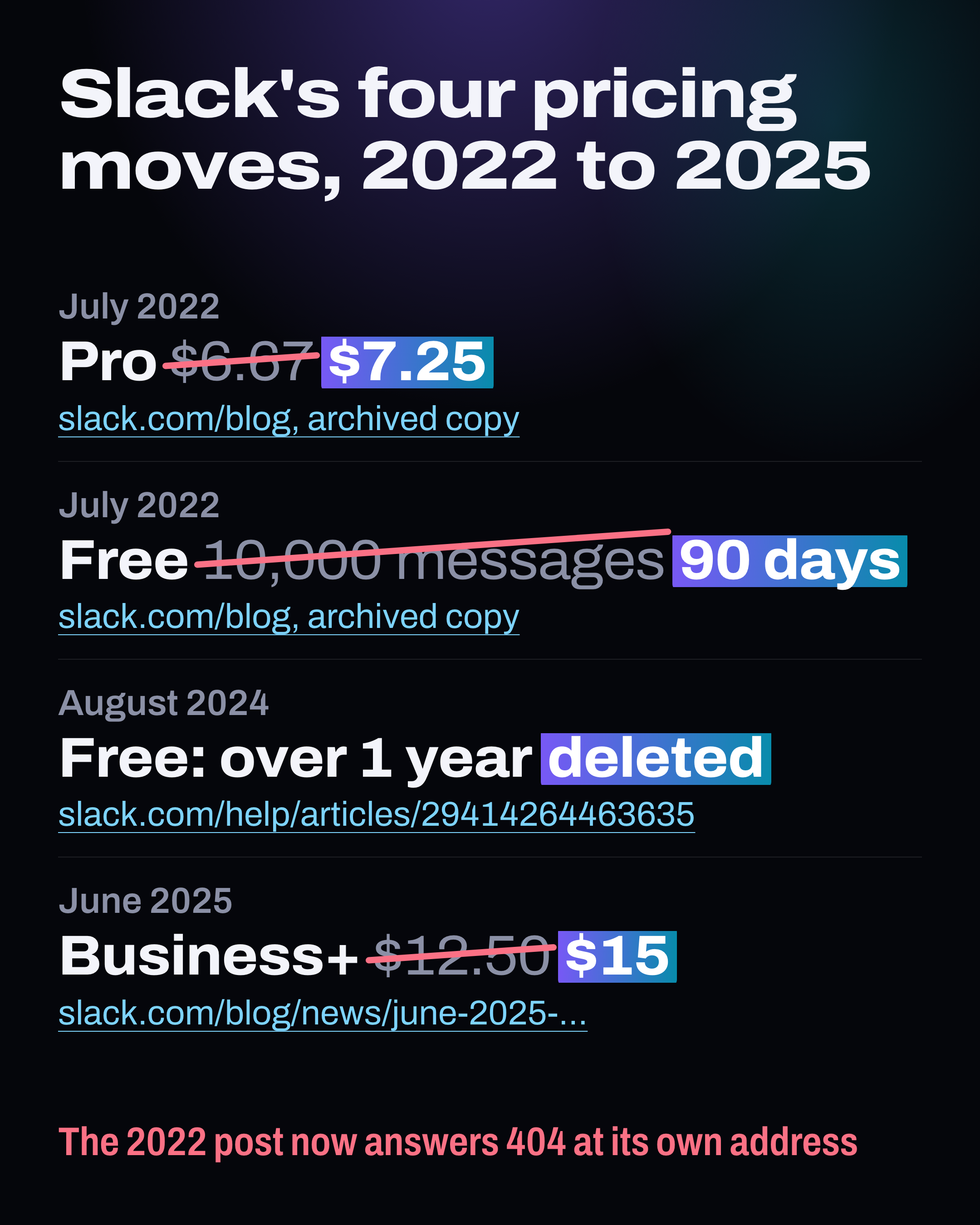
Slack's pricing history from 2022 to 2025 has four moves in three announcements. In 2022 Slack raised Pro and moved its free plan from a message cap to 90 days. In 2024 it started to delete free history older than one year. In 2025 it raised Business+ from $12.50 to $15. Each move came with a post and a notice period.
This case study reads those four moves as a competitor would. A team that sells against Slack, or against any tool that prices like Slack, can learn three things here: how a market leader announces a price move, how it uses the free plan to push the upgrade, and how fast the public record of a change disappears.
July 2022: Pro goes up
On July 18, 2022, Slack announced its first price increase since it launched in 2014. Pro on annual billing went from $6.67 to $7.25 per user a month. Pro on monthly billing went from $8 to $8.75. The change took effect on September 1, 2022, about six weeks after the post.
Three details in that post are worth a competitor's attention.
First, the increase touched only Pro. TechCrunch noted that Business+ and the enterprise plans did not move. The cheapest paid plan carried the change, and the plan most customers compare against stayed still.
Second, Slack framed the increase in cents, "75 cents or less per user", not in percent. The percent was 8.7% on annual Pro and 9.4% on monthly Pro. TidBITS put it at 8 to 9% in its own review.
Third, Slack let customers lock in the old annual rate for one more year if they renewed before September 1. That offer turns a price increase into a reason to renew early. A rival who reads the post in July knows that many Slack contracts renew in August that year, at the old price, for twelve months.
July 2022: free goes to 90 days
The same 2022 post changed the free plan. Before September 2022, a free workspace saw its last 10,000 messages and 5 GB of files, at any age. After it, a free workspace saw the last 90 days, at any volume.
Slack said that "the majority of our active free teams" would see more history under the new rule. The Register reported the same change and added that free users also got Clips and other features. Both points can be true at once. A large, busy free team sends 10,000 messages in a few weeks, so 90 days gives it more. A small, quiet team sends 10,000 messages over a year or more, so 90 days gives it less. TidBITS showed this with its own team's numbers.
For a competitor, the change says something plain. Slack stopped limiting how much a free team talks and started limiting how far back it can look. The teams that rely on their old messages are the teams that pay, and the new rule found them.
Aug 2024: free history deleted
In mid-2024 Slack went one step further. Its help article Updates to message and file history on free workspaces says that from August 26, 2024, Slack deletes messages and files older than one year from free workspaces, on a rolling basis. The free plan still shows the last 90 days. The other 275 days of the year stay hidden until an upgrade. Anything older than a year is gone, and "it will not be possible to restore" it.
TidBITS covered the change on June 24, 2024, about two months before the deletion began. It pointed out what had changed for the upgrade path: before 2024, an upgrade brought back all hidden history. After August 26, 2024, an upgrade brings back one year at most.
The deletion rule changes the reason to upgrade. In 2022 the reason was "see your old messages again". In 2024 it became "keep your messages before they are deleted". A rival with a free plan that keeps history can say so on its own pricing page, with a date and a source. A rival who sells migration can time its outreach to the weeks before a deletion date.
June 2025: Business+ to $15
On June 17, 2025, Slack announced new plans and pricing. The post states that "Business+ plan pricing will increase to $15 from $12.50 per user per month". It also added AI features to Pro and Business+ and introduced a new Enterprise+ plan.
The help article on the change gives the timing. Customers who bought Business+ on the Slack website move to the new version at their first renewal after August 17, 2025. The separate Slack AI add-on is no longer on sale on the website. Slack moved a paid add-on into the plan and raised the plan.
Today Slack's pricing page shows Pro at $7.25 and Business+ at $15 per user a month on annual billing, and $8.75 and $18 on monthly billing. It also shows "50% off for 3 months" on both plans. A competitor who copies the headline price without the offer compares against the wrong number.
Slack pricing history in numbers
The four changes did not move every plan by the same amount. The gap between Pro and Business+ is where the pattern shows.
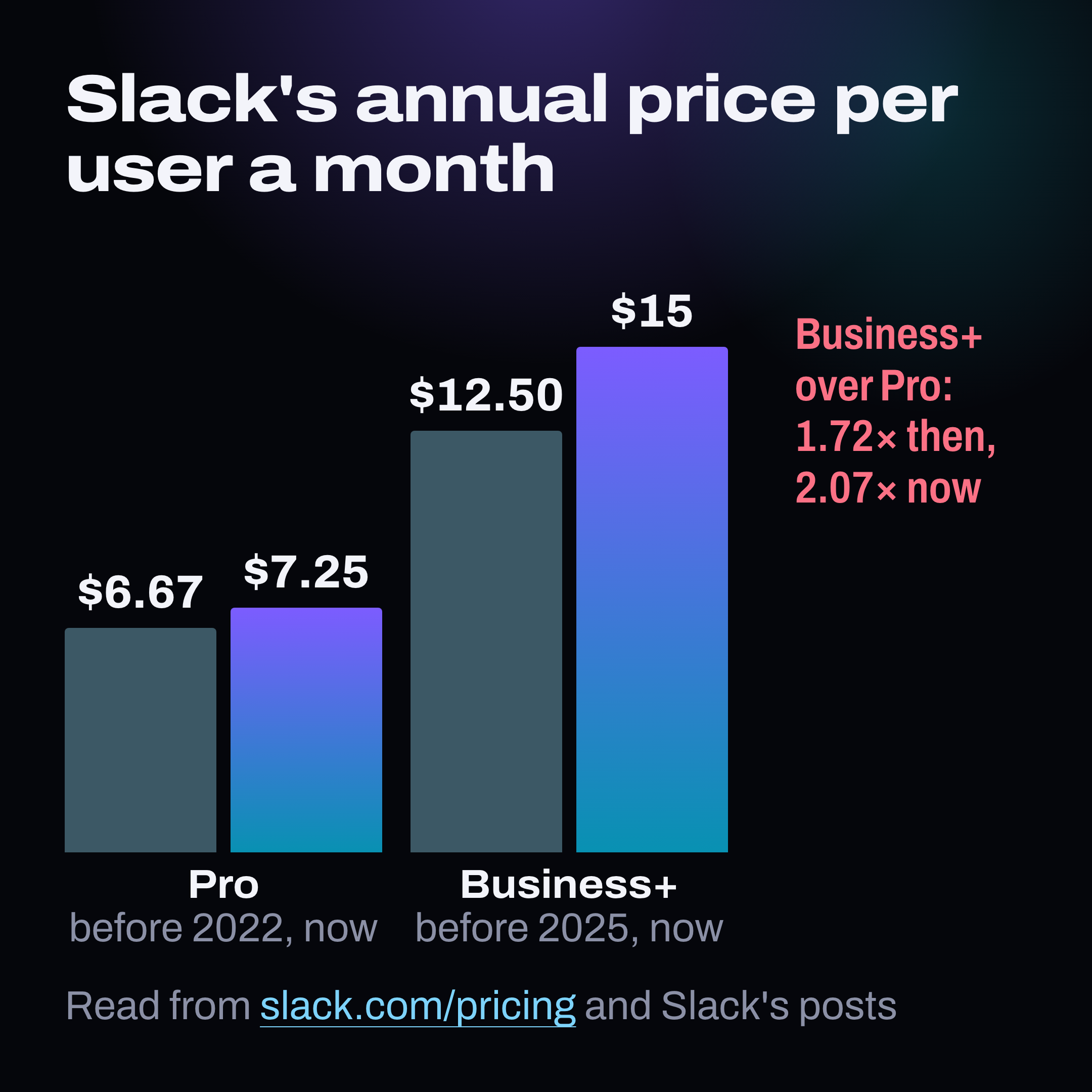
Take a team of 25 people on annual billing that moves from Pro to Business+.
- In late 2022: (12.50 − 7.25) × 25 × 12 = $1,575 a year more for Business+.
- Today: (15.00 − 7.25) × 25 × 12 = $2,325 a year more for Business+.
- The cost of that upgrade grew by $750 a year, or 48%, while Pro itself rose 8.7%.
Business+ cost 1.72 times Pro in 2022 and costs 2.07 times Pro now. Slack bundled AI into Business+ to justify the step. For a rival whose middle plan sits between those two numbers, the gap is the opening. A team that needs SSO or advanced AI, but not the rest of Business+, now pays $2,325 a year for the jump at 25 seats.
The record that disappears
Open Slack's 2022 announcement today at slack.com/blog/news/pricing-and-plan-updates and the page answers 404. The regional copies answer 404 too. The text survives only because the Internet Archive saved it in December 2022, and because reporters quoted it.
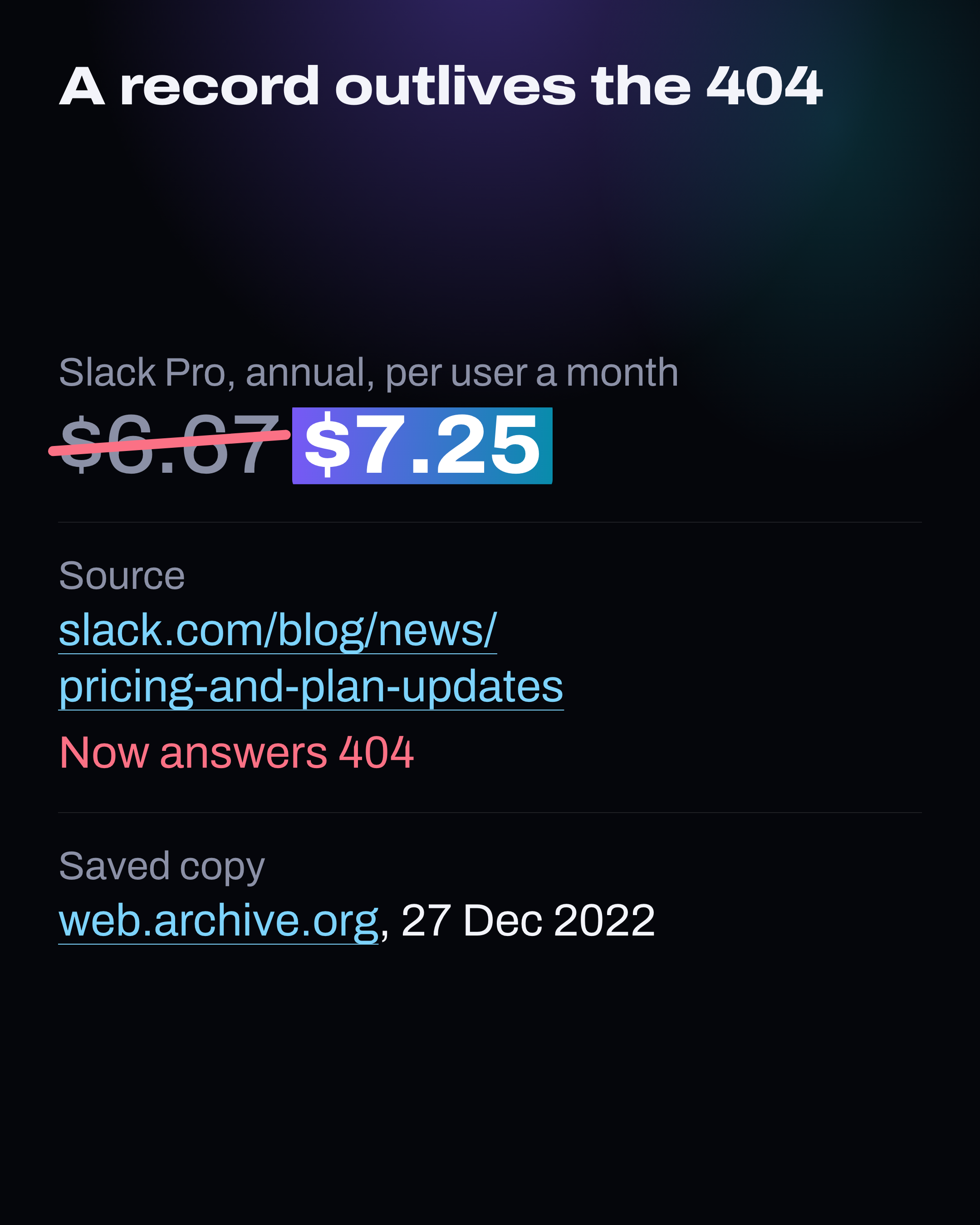
This is the most useful lesson of the case. A competitor's price change lives in four places: the pricing page, the announcement post, the help article and the news. The pricing page shows only the new number. The post can be removed. The help article can be rewritten. If your team did not save the old page on the day it changed, you depend on an archive that may not have it. We made the same point in a screenshot is not a change record: a picture without the address, the date and the old value does not prove a change.
How Seeto keeps the record
Seeto solves the problem this case shows: a competitor's pricing story is spread over pages that change and disappear. You paste your URL and your competitors' URLs. An agent reads their real pricing, features and messaging pages. In 5 to 15 minutes you get a pricing comparison, a features matrix, messaging, a positioning map and battle cards, and every fact carries the page it came from.
On Pro, Seeto re-runs the analysis on a schedule and compares it with the previous run. A move like Business+ from $12.50 to $15 shows up as a change, with the old value, the new value and the page where it happened. You keep the before and after even when the announcement later answers 404. The plans are on the pricing page. When a change does land, the competitor price increase playbook gives the next steps.
Slack pricing questions
When did Slack raise its prices?
Slack raised Pro on September 1, 2022, from $6.67 to $7.25 per user a month on annual billing. It raised Business+ from $12.50 to $15 in its June 17, 2025 announcement.
What happened to the Slack free plan?
In September 2022 the free plan moved from 10,000 messages and 5 GB to the last 90 days. From August 26, 2024, Slack deletes free history older than one year.
Can I still read Slack's 2022 pricing announcement?
Not at its own address: the post answers 404. A copy survives in the Internet Archive, which is why a competitor's pricing record needs its own saved copy.
Pick the three competitors whose prices you quote most often, and record their pricing pages today, with the address and the date. Start a free Seeto analysis to get that record, with a source on every price.