Competitor SLA: what it tells you
A competitor SLA tells you three things their marketing will not: which plan buys a reliability promise, how much an outage costs them in credits, and how hard they make a customer work to claim it. Read the uptime figure, the credit table, the claim window and the exclusions, and you know where they sell reliability and where they only hope for it.
Most teams never open this page. It sits under "Legal", it reads like a contract, and nobody on the product side owns it. That is the reason to read it. The questions below are the ones a founder, a PM or a PMM asks the first time they compare a competitor's SLA with their own.
Which plan does the SLA cover?
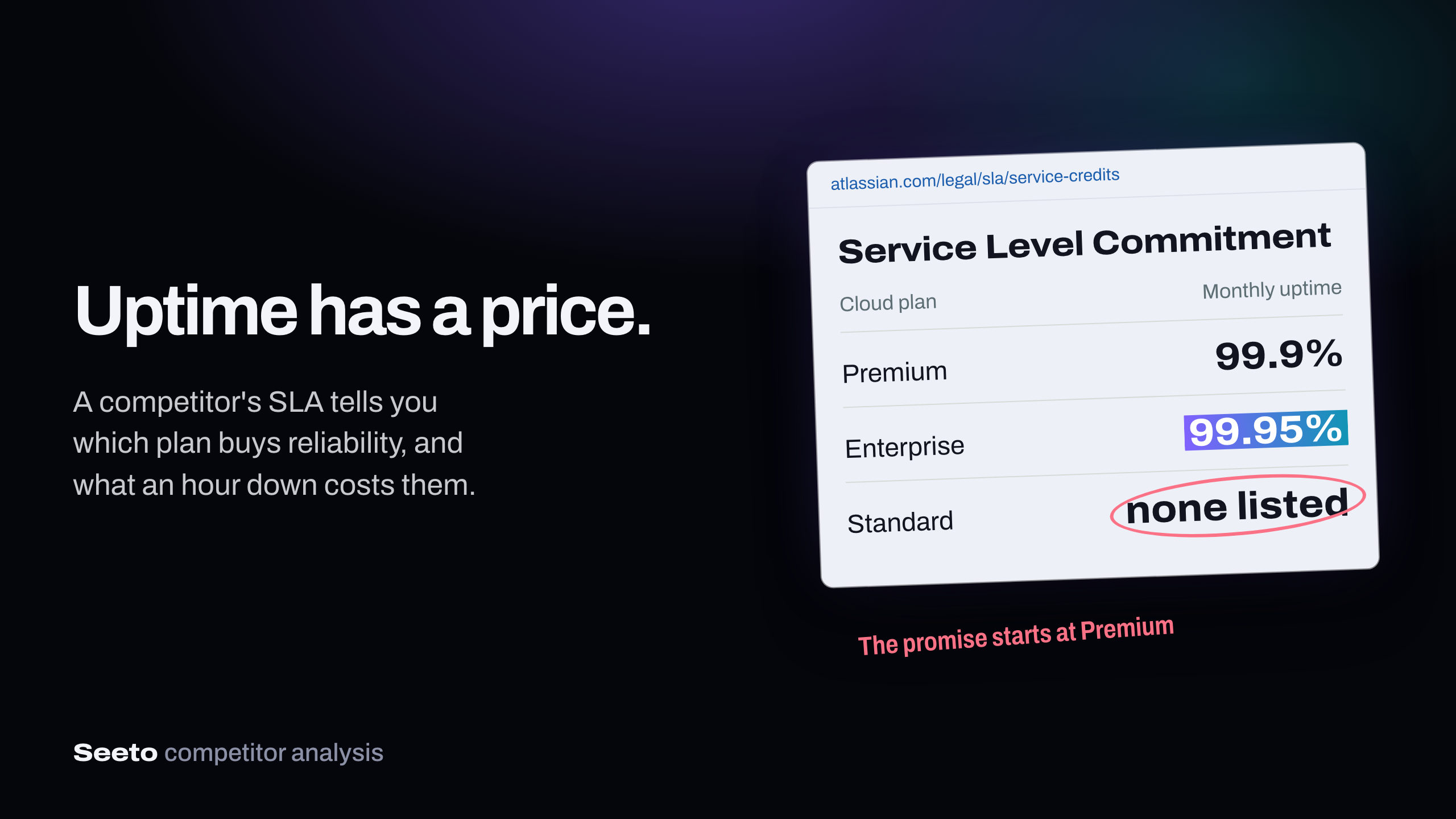
Start here, because the headline number rarely applies to everyone. Atlassian's service level agreement lists a monthly uptime commitment of 99.9% for Premium cloud plans and 99.95% for Enterprise. Standard and Free are not in the table. The promise is a feature of the upper plans, sold like any other.
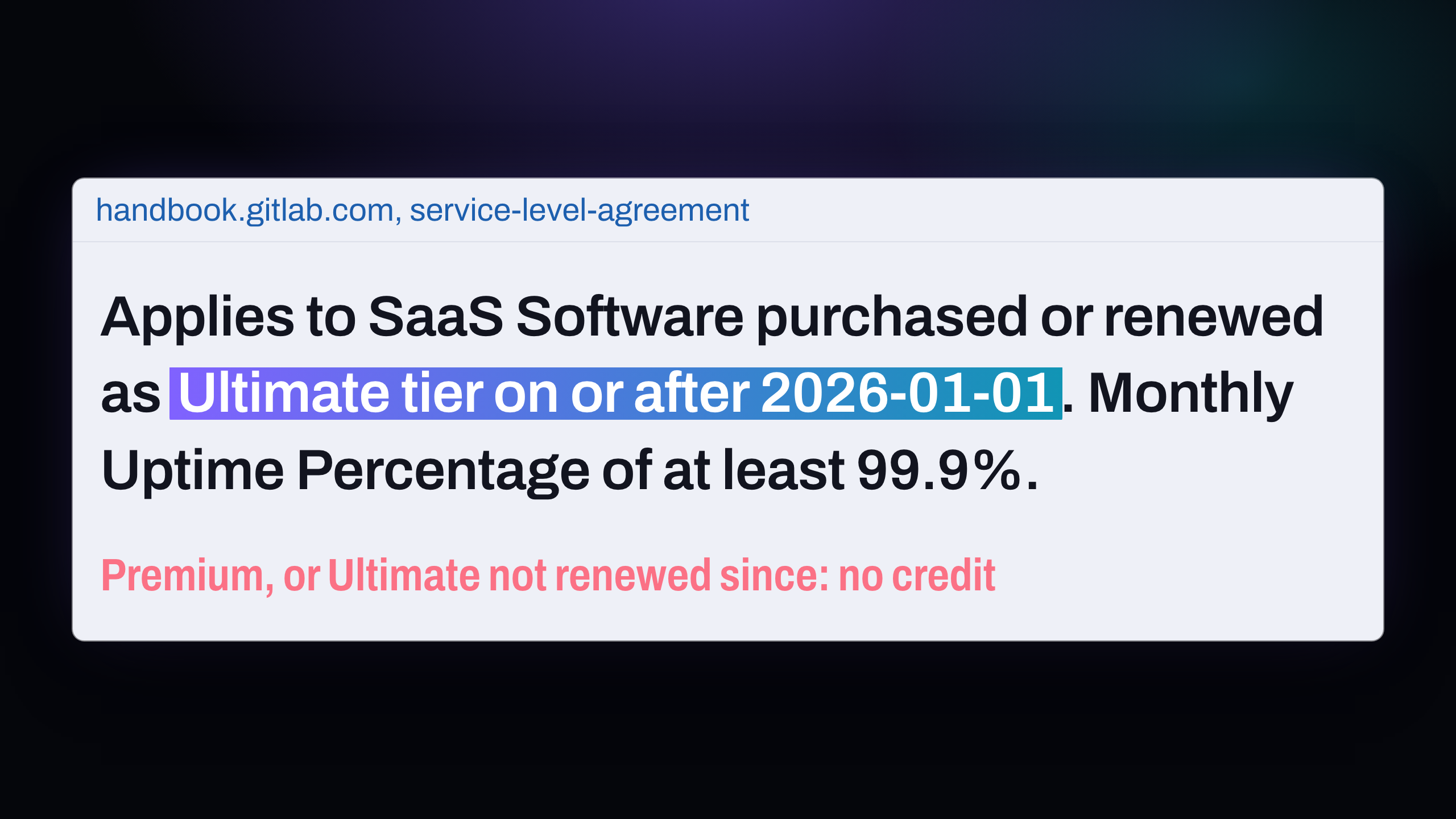
GitLab draws the line by tier and by date. Its availability SLA applies to SaaS bought or renewed as Ultimate on or after 1 January 2026, at 99.9% a month. A customer on Premium, or one who has not renewed since, has no credit to claim.
So the first line of your notes is never "they promise 99.9%". It is "they promise 99.9% on Ultimate, from 2026". That one qualifier tells you which buyer they protect, and which buyer you can talk to about reliability without meeting a contract.
What does an outage cost them?
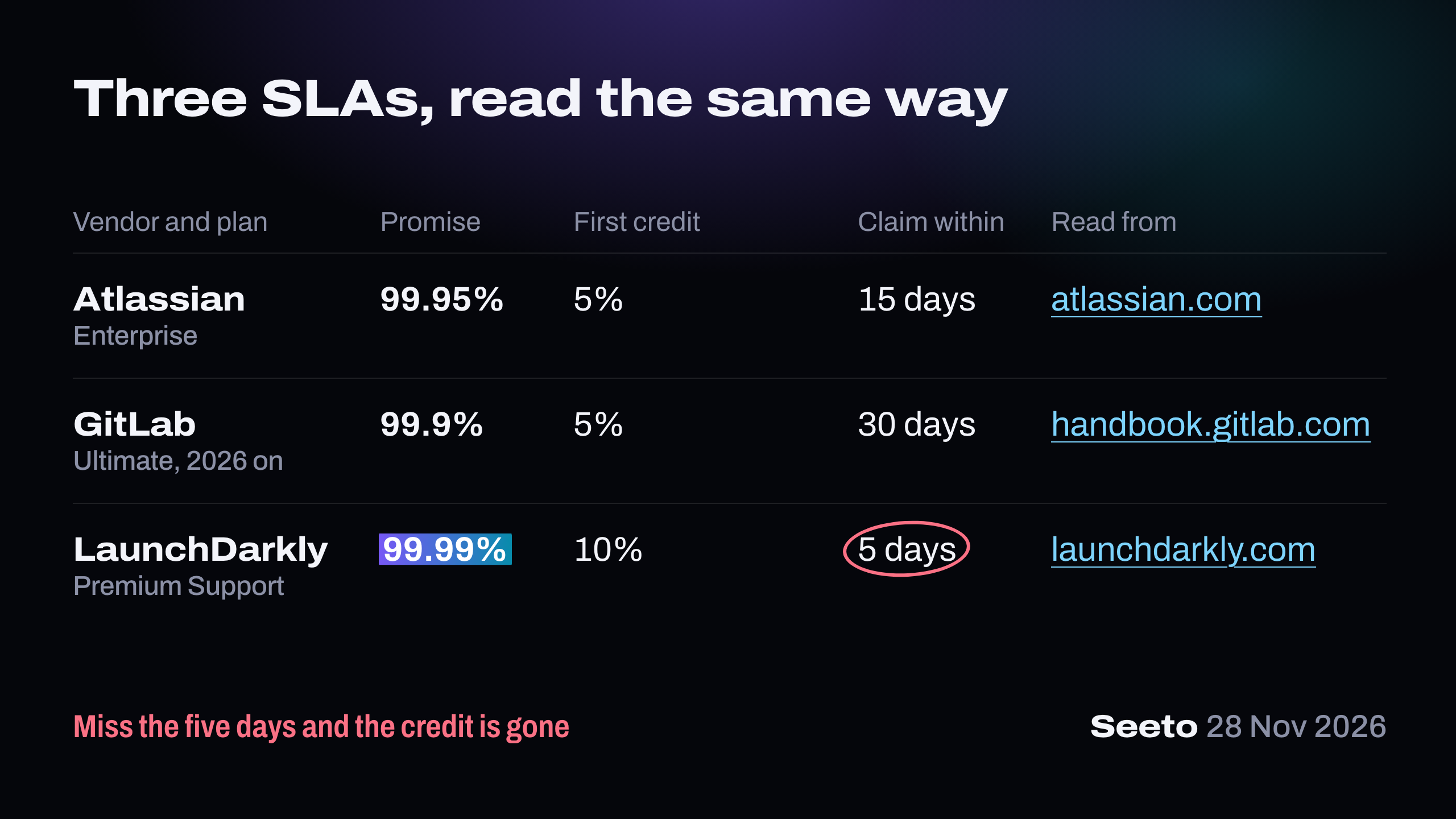
The credit table is the price of a broken promise. Atlassian's Premium table pays 10% of the monthly fee below 99.9%, 25% below 99.0% and 50% below 95.0%. Enterprise adds a first step: 5% between 99.9% and 99.95%. GitLab pays 5% between 99.5% and 99.9%, and 10% below 99.5%.
LaunchDarkly splits its SLA terms by support plan. Premium Support customers get 99.99% and a credit of 10% below it, 25% below 98.0%, capped at 50% of the monthly fee. Enterprise Support customers get 99.9% and no credit table. Their remedy is the right to end the contract after two consecutive missed months.
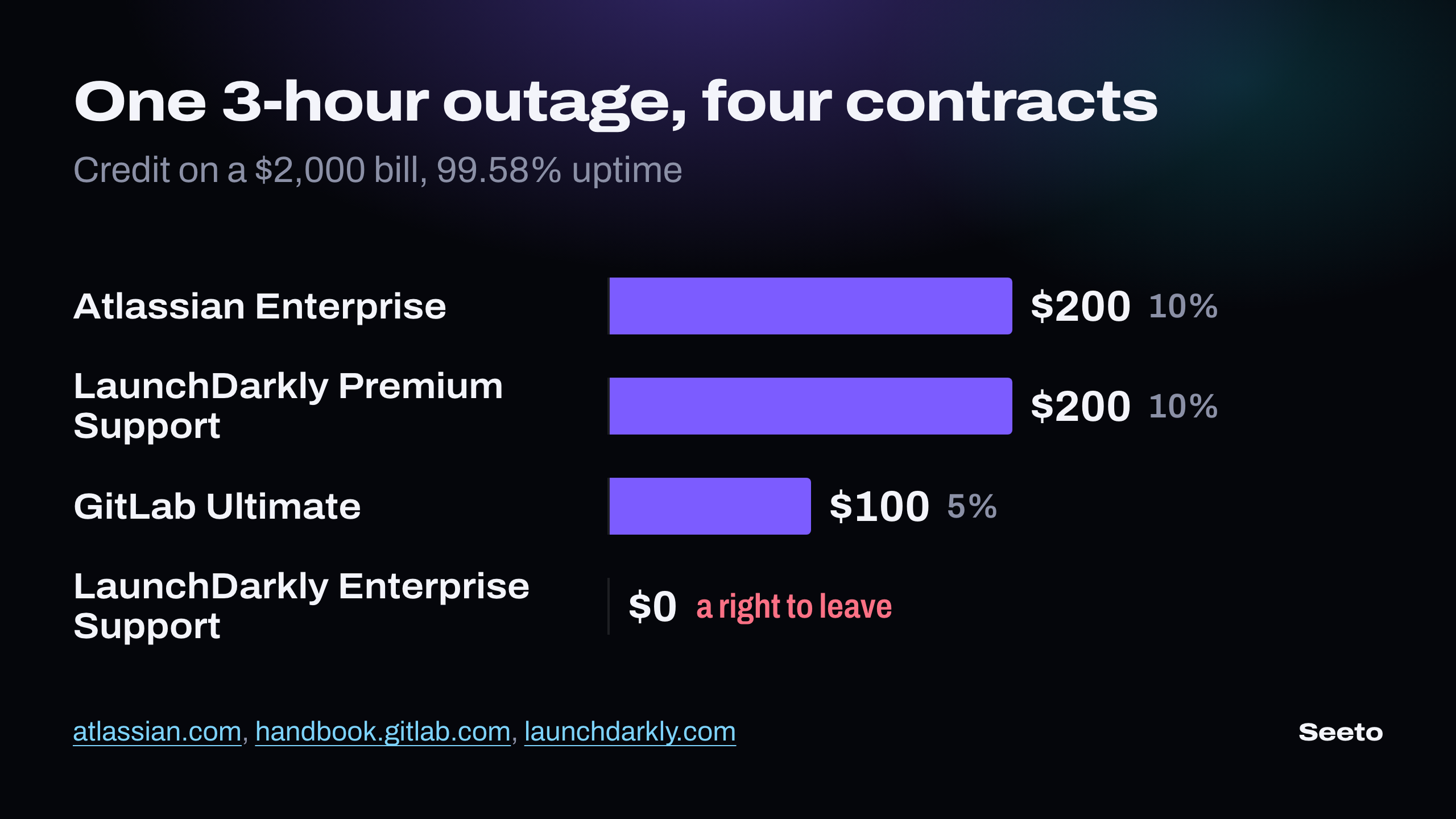
Here is the arithmetic for one bad month. A 30-day month has 43,200 minutes. A three-hour outage is 180 minutes, so downtime is 180 / 43,200 = 0.42%, and uptime is 99.58%. On a $2,000 monthly bill:
- Atlassian Enterprise: below 99.9%, so 10%, which is $200.
- LaunchDarkly Premium Support: below 99.99%, so 10%, which is $200.
- GitLab Ultimate: between 99.5% and 99.9%, so 5%, which is $100.
- LaunchDarkly Enterprise Support: no credit, $0.
The point is not the $200. It is how small the number is next to a lost day of work. A credit of 5% or 10% is a signal of confidence, not compensation. A vendor that pays 50% at the bottom of its table is telling you it does not expect to get there.
Is a higher number a better promise?
Not on its own. Four other terms decide what the number is worth.
The claim window comes first. Atlassian wants a support ticket within 15 days after the end of the month. GitLab gives 30 days. LaunchDarkly wants a claim within 5 days of the incident, with the words "SLA credit" in it. A 99.99% promise with a five-day window asks more of the customer than a 99.9% promise with thirty. A missed window costs the customer the whole credit.
Then the measure. Atlassian says its own monitoring is "the sole source of truth" for whether it met the commitment. GitLab checks a claim against its internal monitoring too. If the vendor's numbers decide, your status page screenshots do not.
Then the exclusions. Atlassian leaves out scheduled and emergency maintenance under its maintenance policy, third-party products and sandbox instances. LaunchDarkly subtracts scheduled maintenance from both sides of its uptime sum.
Last, the form of the credit. Atlassian applies credits to a future payment, with no refunds or cash value. GitLab puts them on the next invoice and states that no credit results in a refund. A customer who leaves after an outage takes nothing with them.
What if there is no SLA?
That is a finding, and a common one. Jitbit's founder went through the legal pages of 31 SaaS products in an older review and found no public uptime commitment for 21 of them, Stripe, Shopify and Salesforce among them. GitLab was on that "none" list too, and it publishes an SLA now. So check each name again before you quote it.
No public SLA can mean three things. The company sells to small teams who never ask for one. It negotiates SLAs only inside enterprise contracts. Or it does not trust its own numbers yet.
Read the plan page and the trust page next to it to tell which. An "Enterprise" column that says "custom SLA" points to the second.
For your sales team the answer is the same in all three cases. If your product has a public commitment and theirs does not, that is a line on the battle card, and it is checkable by the buyer in one click.
How do you use their SLA in a deal?
Use it the way the buyer's procurement team will, because they will read it anyway.
- Put your own SLA next to theirs, term by term: plan covered, uptime, first credit, cap, claim window, exclusions.
- Find the term where yours is plainly better and lead with it. A buyer understands "30 days to claim" against "5 days" without a slide.
- Find the term where theirs is better and prepare an honest answer. Do not hide a weaker number. Procurement will find it.
- Pair the promise with the record. Their status page history shows whether the promise has been kept.
- Quote the page, with its address and the date you read it. A contract term without a source is a rumour.
How do you see the SLA change?
SLA pages change quietly, and the change is often the news. GitLab's current terms carry a start date, 1 January 2026, and the older review above listed GitLab with no SLA at all. A new tier in the table, a credit step removed or a claim window cut from 30 days to 15 each tells you where the company is moving: up-market, cost-cutting, or into a new reliability bet.
Nobody re-reads a legal page every month by hand. Seeto does that reading for you. You give Seeto your URL and your competitors' URLs, and an agent reads their real pages.
In 5 to 15 minutes you get a pricing comparison, a features matrix and battle cards. Every fact carries the page it came from, so procurement can check it in one click.
On Pro, Seeto re-runs the analysis on a schedule and compares it with the previous run. A plan that moved or a term that changed shows up as a change, with the page where it happened. The same goes for other pages that move without an announcement, such as a subprocessor list.
Run a Seeto analysis on your two closest competitors, and put their plan terms next to your own SLA.