Subprocessor list: read a rival's stack
A subprocessor list is a public page where a SaaS company names each third party that handles its customers' personal data: the cloud host, the data warehouse, the email sender, the AI model vendors. Read your competitor's subprocessor list as a tech stack with dates. It shows what they buy instead of build, and the update log shows when each choice was made.
I opened the subprocessor pages of seven companies on 18 November 2026: Asana, Intercom, GitLab, HubSpot, Zendesk, Stripe and PostHog. I also opened the text of the law that explains why these pages exist. Every name, date and count below comes from those pages, with a link on the words that state it.
Most competitor research reads the pages a company wrote to persuade: the homepage, the pricing page, the launch post. The subprocessor list is a page the company wrote because a contract told it to. Nobody polished it, and that is its value.
What a subprocessor list is
Asana gives the plain definition: a subprocessor is a third-party engaged by Asana and/or Asana affiliates to process personal data about Asana customers. The SaaS company processes data for its customer, and the subprocessor processes it for the SaaS company.
The list is public because of one sentence in European law. GDPR Article 28 says a processor must inform the controller of any intended changes concerning the addition or replacement of other processors, so that the customer has the opportunity to object.
A company with ten customers can send ten emails. A company with thousands of customers puts the list on a public page and adds a subscription form. Asana's page asks readers to subscribe to receive notifications of subprocessor changes, and GitLab's page has a sign-up to be notified of a change to the list.
Nothing on these forms asks you to be a customer. The vendor wants every buyer's security team to find the page fast, so the page is open to you as well.
What the list shows
Each row has three or four fields: the vendor's legal name, the service it provides, the country, and sometimes the product it applies to. One row is one buying decision that your competitor made.
GitLab's list has 16 third-party rows. Four of them say more than a product page would. HiddenLayer provides Prompt Injection Security for AI-Powered Product Features. Decagon AI is the First-Line Customer Support Agent. IntouchCX, in India, does Outsourced Customer Support Business Processes. ClickHouse does Database Hosting for GitLab.com and Dedicated.
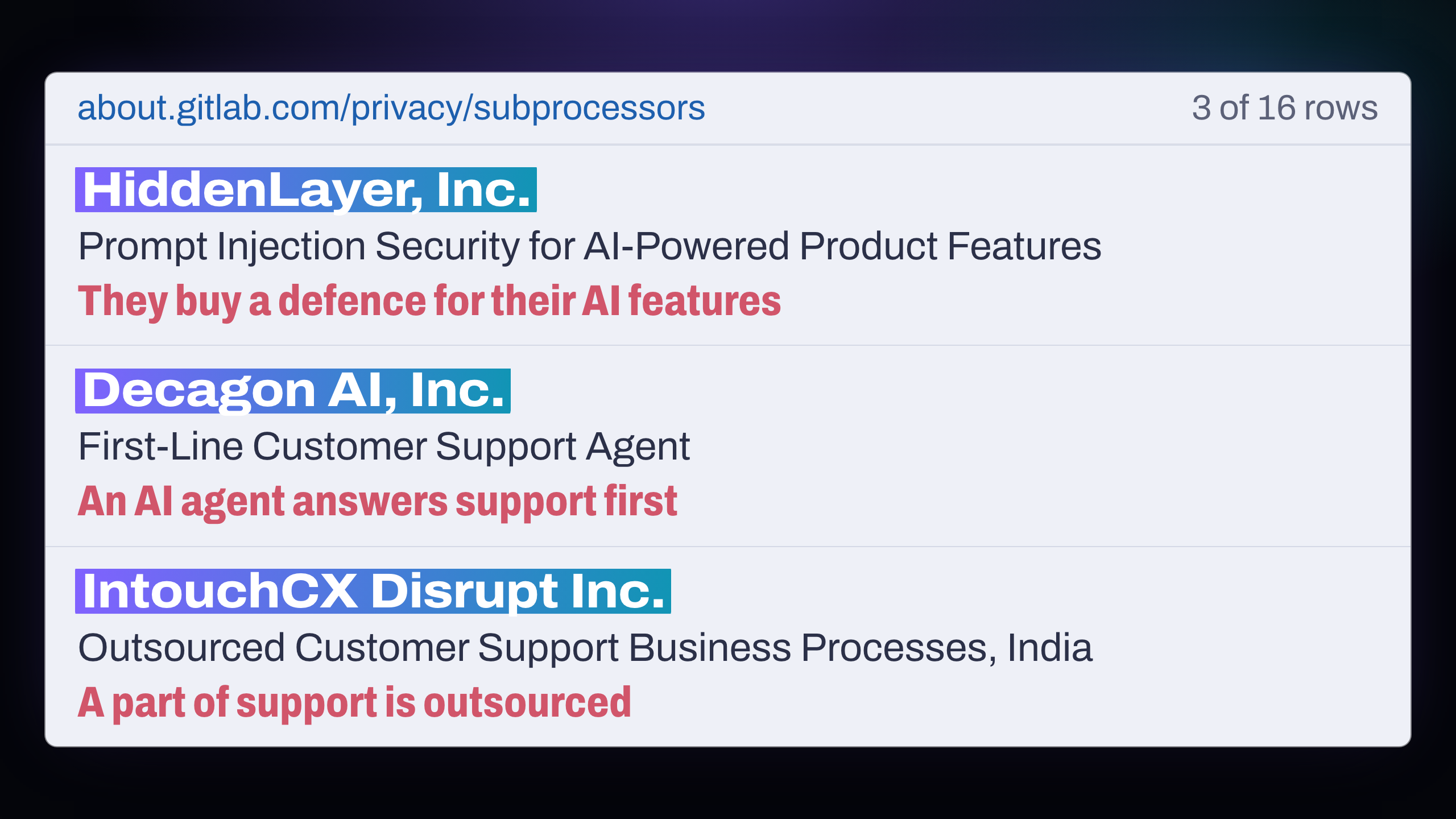
Read those rows as a competitor would. GitLab treats prompt injection as a risk large enough to buy a product for. An AI agent answers support before a person does. A part of support is outsourced. None of this is on the pricing page, and all of it affects what GitLab can promise a customer.
The location column matters too. Intercom's list has three versions: one for US hosting, one for EU hosting and one for Australia. The Australian version says that AI processing via models hosted on AWS Bedrock services occurs in the USA. If you sell against Intercom to an Australian buyer who needs data to stay in the country, that sentence is your opening question.
Read the AI rows first
The fastest-changing part of any list in 2026 is the AI part. It answers a question that marketing pages avoid: whose models run behind the feature.
Intercom's US list has 14 rows. Six of them name AI processing as the service: OpenAI, Anthropic, Google, Microsoft, Eleven Labs and Cartesia AI. Two more, Amazon Web Services and Snowflake, say their processing includes AI processing. That is 8 of 14 rows, or 57% of the list.
GitLab's 16 rows include seven with AI in the service column: Google, Amazon Web Services, Anthropic, Fireworks.ai, OpenAI, Glean and HiddenLayer. A vendor that lists four or more model providers is routing between them. A vendor that lists one has made a bet.
Some lists split AI into a separate table. PostHog's page has four core subprocessors (Amazon Web Services, Cloudflare, Modal Labs and Wiz) and a second tab named Third-Party AI Subprocessors (Only if AI Features are Enabled). That split is itself a product fact: AI is optional there, and a customer can refuse it.
The log is a dated roadmap
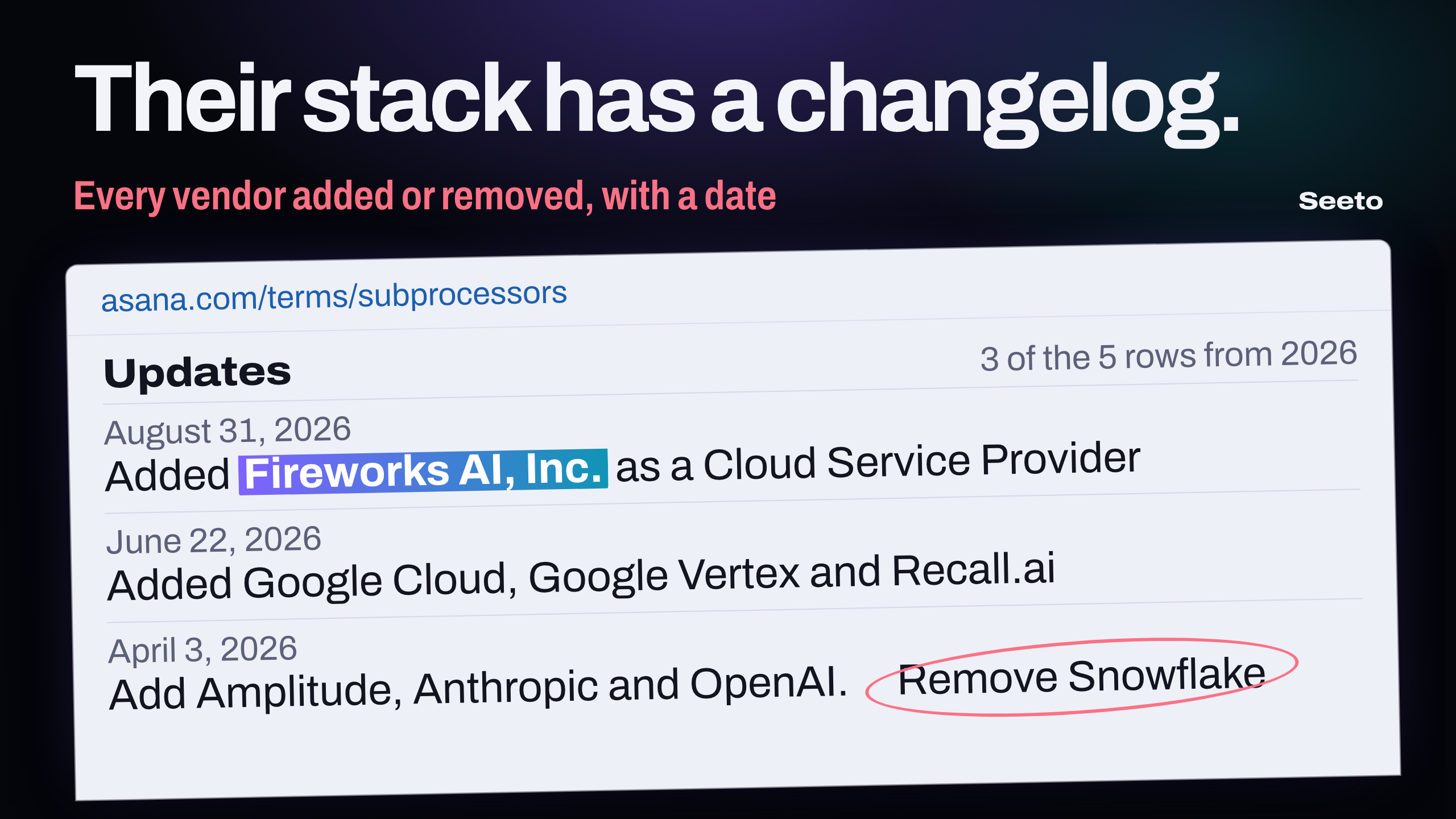
A list shows the stack today. An update log shows the order in which it was built. Asana keeps the best one I found: a table named Updates, with a date and a change in each row.
Here is the worked example. Asana's log has 15 rows, from November 1, 2021 to September 11, 2026. By year the count is 1, 2, 3, 1, 3 and 5, and 1 + 2 + 3 + 1 + 3 + 5 = 15.
Now count the rows that name an AI vendor or an AI service. In 2021 and 2022 there are none: 0 of 3. In 2023 there are two: Added OpenAI, LLC as subprocessor on April 27 and Added Anthropic, PBC on September 12. In 2024 there is one, for AI chat functionality. In 2025 there are two: AWS Bedrock on April 14, and Cloudflare on May 1 for the Model Context Protocol server.
In 2026 all five rows are AI rows: Anthropic and OpenAI on April 3, StackAI as an affiliate on May 28, Google Vertex and Recall.ai on June 22, Fireworks AI on August 31, and a rename of the OpenAI and Google entries on September 11. The sum is 0 + 2 + 1 + 2 + 5 = 10 of 15 rows, or 67%. From 2023 on it is 10 of 12, or 83%.
Three things in that log are competitive facts. Asana added a second model vendor less than five months after the first. On April 3, 2026 it removed Snowflake in the same row that added Amplitude, which is a warehouse and analytics change. And on May 1, 2025 the log said the Asana Model Context Protocol server is hosted on Cloudflare Workers, which tells you what they built and where it runs.
The May 28, 2026 row is a different kind of fact. An affiliate row with a new company name is an acquisition that has reached the legal pages.
Compare two versions
Not every vendor keeps a log. Some keep the previous version instead, and you make the log yourself.
Intercom's page links to its prior version. The prior version is effective April 9, 2025 and has 11 rows for US hosting. The current one is effective June 25, 2026 and has 14 rows. 14 − 11 = 3 new rows, and no row was removed.
The three new rows are Eleven Labs, Cartesia AI and Ably Realtime. Two of the three have the same service: AI processing (text to speech). A support product that adds two speech vendors in one revision is building a voice channel. You could read that from the list before you read it in a launch post.
When there is no prior version on the page, keep your own. Save the text of the list with its date each time you read it. A dated text copy that you can compare is the record you need, and a screenshot is not a change record.
The 30-day notice window
The law says intended changes. So the list changes before the product does, and the contract says how many days before. You hear about a vendor before the feature ships.
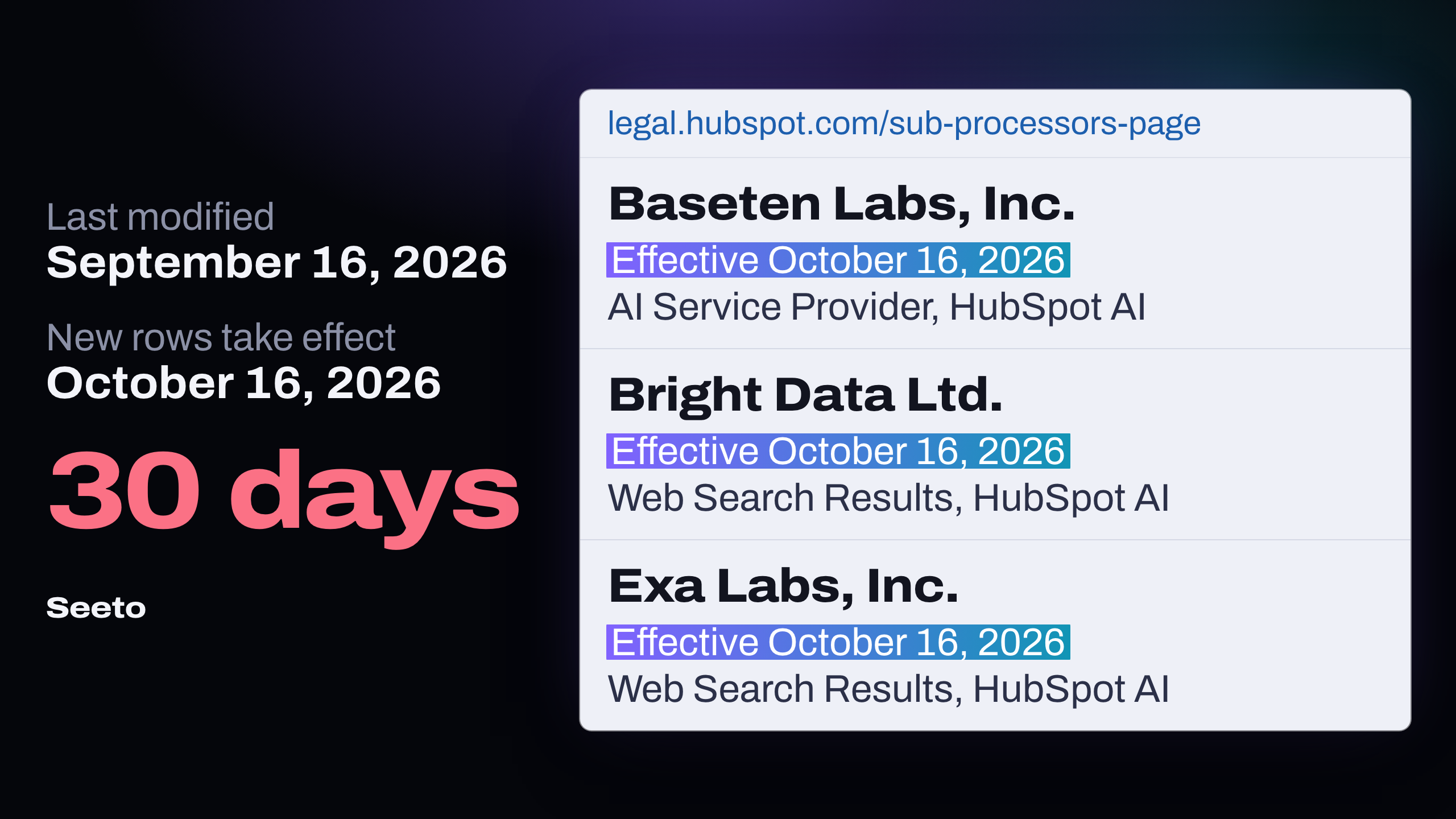
HubSpot promises subscribers a notice at least 30 days prior to any such change taking effect. Its page was last modified on September 16, 2026, and three rows carry the label Effective October 16, 2026: Baseten Labs as an AI service provider, and Bright Data and Exa Labs for web search results, all three for HubSpot AI. September 16 to October 16 is 30 days.
Zendesk's policy shows the same window. The updated version is effective for new customers as of November 10, 2026, and for existing customers as of December 10, 2026: 30 days again. Intercom's DPA says it will notify customers at least twenty (20) days prior to any such changes. Stripe gives a business user 30 days following the update to object.
So a subscriber to a competitor's list learns about a new vendor 20 to 30 days before that vendor touches customer data. Two web-search vendors on HubSpot's list, dated a month ahead, describe an AI feature that searches the web. That is an early signal, with a date on it, from the competitor's own page.
Read a list in 20 minutes
- Find the page. Search the competitor's name with "subprocessors" or "sub-processors". It is usually linked from the DPA, the privacy page or the trust center.
- Copy the rows into a sheet: vendor, service, country, product. Add the address of the page and today's date.
- Sort the rows into groups: hosting, data, messaging, AI, support, payments.
- Mark the AI rows. Count the model vendors and note which features each one serves.
- Read the update log or the prior version. Write each change as a dated line.
- Subscribe to the change notices, where the page offers them.
- For each new row, open the competitor's product pages and find the feature that the vendor serves.
Step 7 is the one that most teams skip. A row is a lead, not a conclusion. Eleven Labs on a list suggests voice; the product page for a voice agent confirms it. Keep the two addresses together, because every competitor claim needs a source link.
Mistakes to avoid
- Reading the list as the whole stack. It names only the vendors that process customers' personal data, so code hosting, design tools and finance systems are usually absent. For the parts the list leaves out, DNS records show another slice of the vendor stack.
- Reading a row as usage. A vendor on the list may serve one optional feature for a few accounts. Asana's Feature-Specific table and PostHog's AI tab both say that the row applies only if the feature is on.
- Reading a legal-name change as a product change. Asana's September 11, 2026 row renames OpenAI to OpenAI OpCo, LLC. The contract moved to a new legal entity, and the product did not change that day.
- Comparing the length of two lists. PostHog shows four core rows and GitLab shows 16. The counts depend on how each legal team defines a subprocessor, so compare the groups, not the totals.
Where Seeto fits
The hard part of this work is not reading one list once. It is connecting a legal row to what the competitor sells, and seeing it again when it changes. That is the problem Seeto solves.
You paste your URL and your competitors' URLs, and an agent reads their real pages. In 5 to 15 minutes you get a features matrix, a pricing comparison, messaging, a positioning map, SEO, battle cards and a competitive score. Every fact carries the page it came from, so a lead from a subprocessor row has a product fact with a source next to it.
On the Pro plan, Seeto re-runs the analysis on a schedule and compares it with the previous run. When a competitor's list gains a speech vendor in June, the next run shows whether a voice feature, a new plan or a new claim has reached their product and pricing pages, and where. The plans and their limits are on the pricing page.
The checklist
- The address of the subprocessor page, and the date you read it
- The rows, in groups: hosting, data, messaging, AI, support, payments
- The model vendors, and the features they serve
- The last three changes, each with its date
- The notice period from the DPA, in days
- One product page that confirms each new row
What is a subprocessor list?
It is a public page where a SaaS company names each third party that processes its customers' personal data: the cloud host, the email sender, the AI model vendors, the support tools. Most lists give the vendor's legal name, its service and its country.
Why do SaaS companies publish their subprocessors?
GDPR Article 28 says a processor must tell its customers about each added or replaced processor, so that a customer can object. A public page with an email subscription is the cheapest way to do that for thousands of customers.
Is it legal to read a competitor's subprocessor list?
Yes. The page is public, and the vendor publishes it so that anyone who evaluates the product can read it. Many vendors also let anyone subscribe to change notices by email.
How often does a subprocessor list change?
It depends on the vendor. Asana's update log has 15 rows from November 2021 to September 2026, and five of them are from 2026. A team that ships AI features changes its list several times a year.
Start with one competitor
Pick your closest competitor and open its subprocessor page today. Write down the AI rows and the last three changes. Then start a free Seeto analysis with their URL and yours, and check each row against what their product pages say.