SaaS annual discount: six questions before you set it
A SaaS annual discount on most pricing pages sits between 15% and 20%, which is close to two months free. Set yours from two inputs: your monthly churn, which fixes the largest discount that still pays, and your competitors' pricing pages, which fix what a buyer expects to see. The six questions below cover both.
What is a normal SaaS annual discount?
The common range is 15% to 20%. InnerTrends compared 100 SaaS pricing pages and found that more than half of the companies that discount an annual plan set it between 15% and 20%. The full range on cheaper packages ran from 7.4% to 44%. In the same sample, 41 companies sold monthly plans only and 9 sold yearly plans only.
Baremetrics describes the same habit: most SaaS companies offer both terms and use a 15-20% annual discount to move buyers to the longer one.
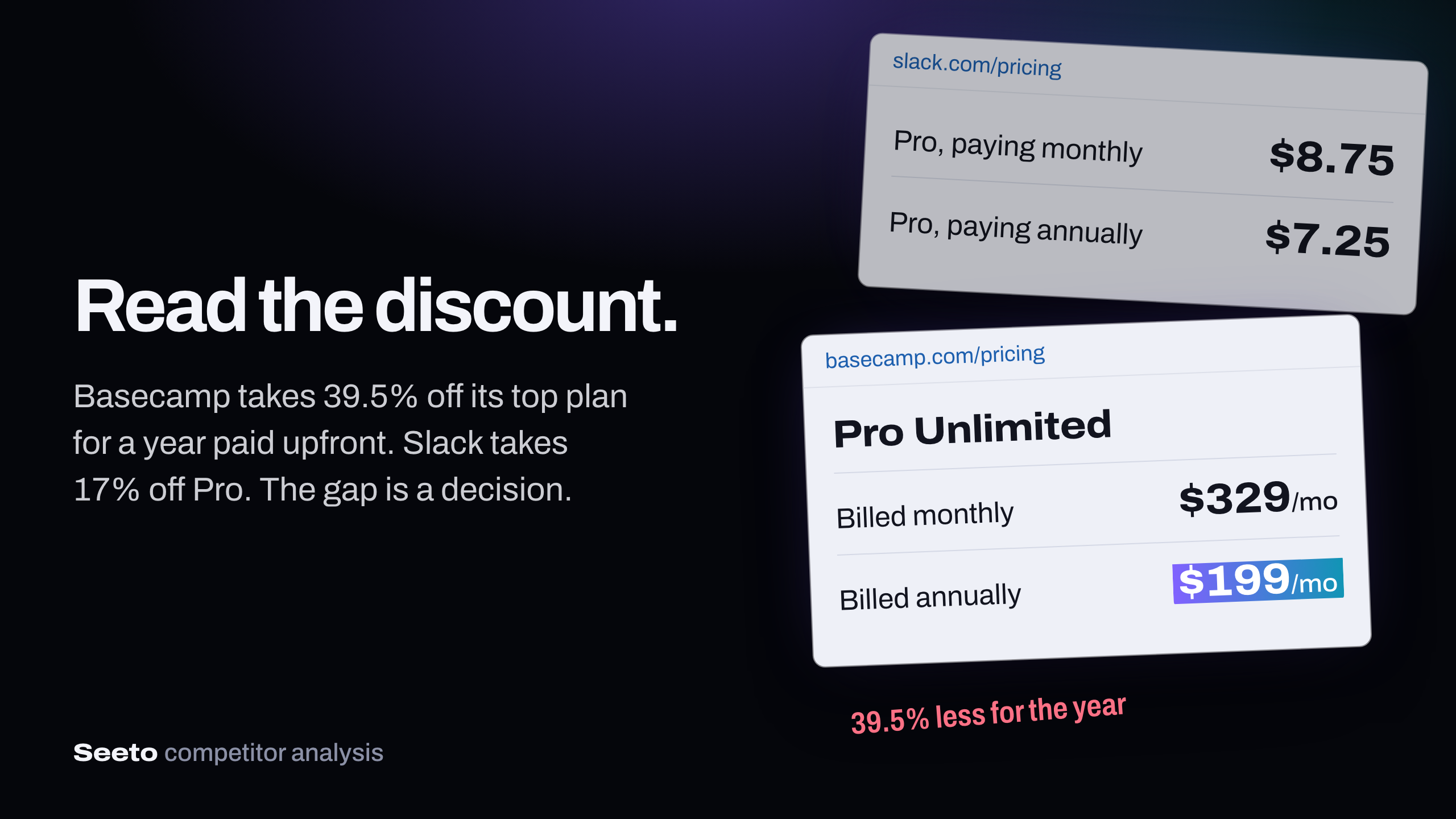
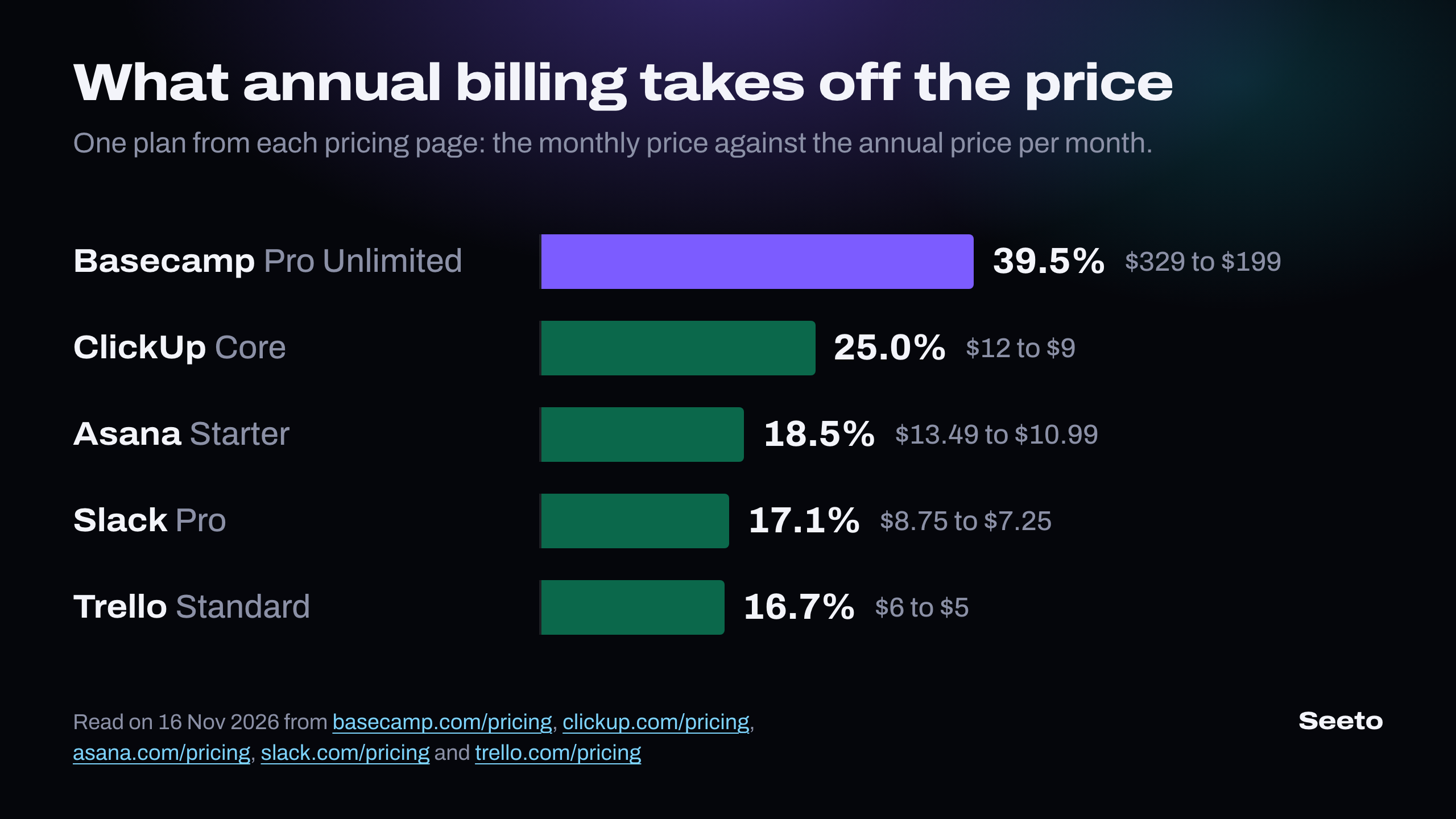
I opened five pricing pages on 16 November 2026 to see where real vendors sit. Slack lists Pro at $8.75 a user when paying monthly and $7.25 when paying annually. Asana lists Starter at $10.99 billed annually and $13.49 billed monthly. Trello lists Standard at $5 if billed annually and $6 billed monthly. Those three land between 16.7% and 18.5%.
Two pages sit well outside the range. ClickUp shows Core at $9 beside a regular price of $12 on its yearly view. Basecamp shows Pro Unlimited at $199 a month billed annually, and $329 if billed monthly.
"Two months free" is the same offer in other words. The buyer pays for 10 months and gets 12, which is 2 / 12, or 16.7%. Trello Standard is exactly that.
How do you calculate a competitor's annual discount?
Use one formula for every page: the monthly price, minus the annual price per month, divided by the monthly price.
- Slack Pro: ($8.75 - $7.25) / $8.75 = 17.1%
- Asana Starter: ($13.49 - $10.99) / $13.49 = 18.5%
- ClickUp Core: ($12 - $9) / $12 = 25.0%
- Basecamp Pro Unlimited: ($329 - $199) / $329 = 39.5%
Calculate the number yourself. Do not copy the badge. Asana's toggle says "Save up to 18%", and its Starter plan works out to 18.5%. ClickUp's toggle says "Save up to 33%", and its Core plan works out to 25%.
A badge states the best case on the page, in round words. Your comparison needs the same arithmetic on every row.
Then turn the discount into a break-even month, because that is how a buyer feels it. Twelve months of Slack Pro on annual billing cost 12 x $7.25 = $87. At the monthly price, $87 pays for $87 / $8.75 = 9.9 months. A buyer who expects to stay ten months or more takes the annual plan.
On Basecamp Pro Unlimited the year costs 12 x $199 = $2,388, and $2,388 / $329 = 7.3 months. Basecamp asks for far less certainty before the annual plan wins.
Before you record anything, check which price the page showed you. Many pricing pages open with the annual toggle on, so the large number on screen is the discounted one. We wrote about that trap in whose competitor price you actually captured.
Does the discount change between plans?
On some pages it does, and the direction tells you which plan the vendor wants a committed buyer on.
Trello's discount grows from 16.7% on Standard to 20% on Premium, which is $10 billed annually against $12.50 billed monthly. ClickUp's grows from 25% on Core to 32% on Business, at $17 beside a regular price of $25. Calendly labels its plans the same way: the Standard plan carries "Save 17%" and the Teams plan carries "Save 20%".
Asana and Slack keep the discount flat. Asana Advanced is $24.99 against $30.49, or 18.0%. Slack Business+ is $15 against $18, or 16.7%.
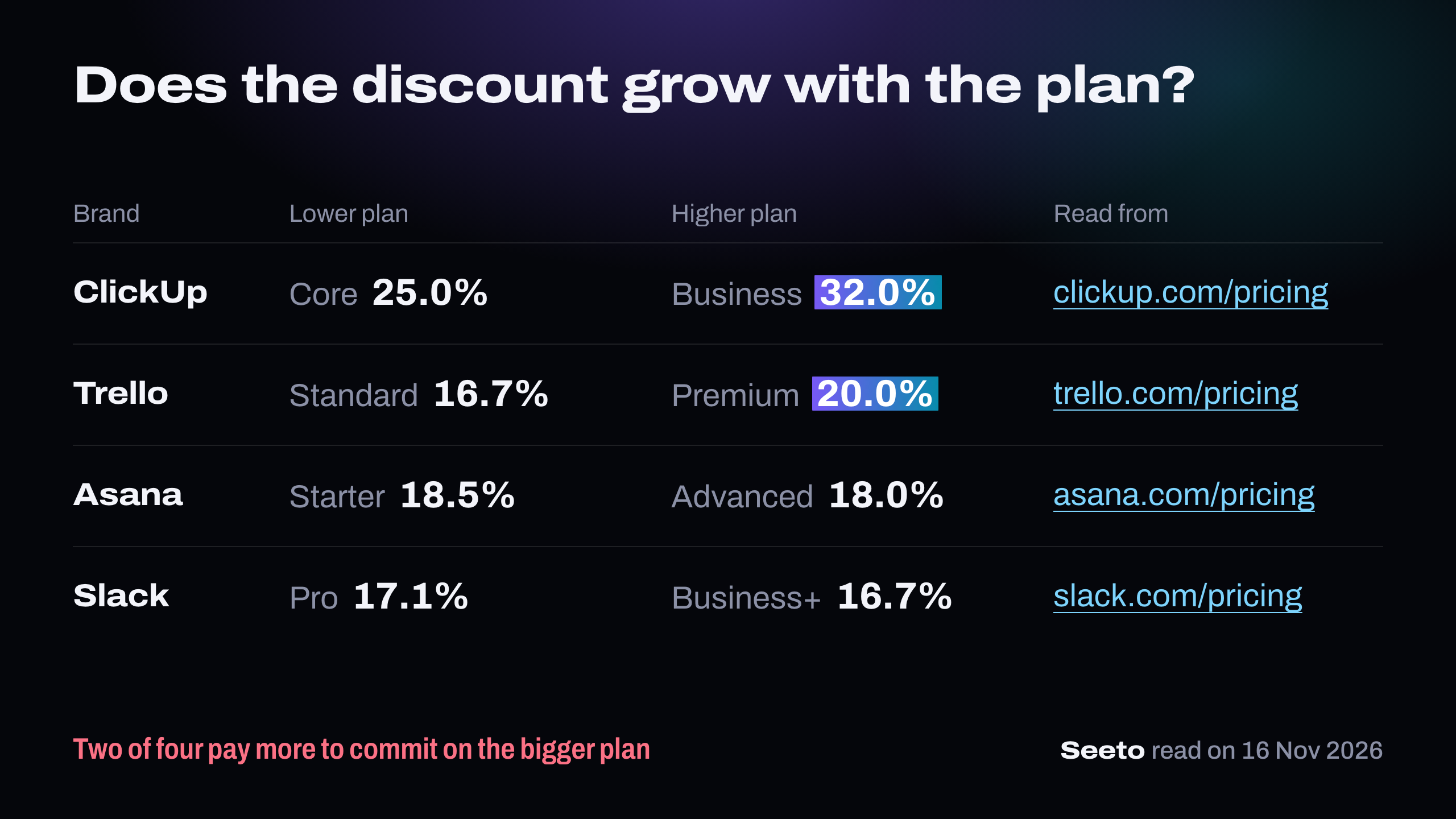
A flat discount says the vendor treats the term as a billing choice. A discount that grows with the plan says the vendor pays extra for a year of commitment where the contract is larger. If your competitors do the second and you do the first, your higher plan looks expensive on an annual quote even when the monthly prices match.
How large can the discount be before it costs you?
The answer depends on your monthly churn. A customer on monthly billing pays until they cancel. A customer on annual billing pays for twelve months on day one. The discount pays for itself in the first year when the upfront amount is larger than what the monthly customer would have paid before leaving.
Take Larkmail, a made-up product at $50 a month, with an annual plan at 20% off: $40 a month, $480 upfront.
At 5% monthly churn, the share of customers still paying in month 12 is 0.95 to the power of 12, or 0.540. The expected number of monthly payments is (1 - 0.540) / 0.05 = 9.19. Monthly billing collects 9.19 x $50 = $459.64 for each customer who starts. The annual plan collects $480, which is $20.36 more.
At 3% monthly churn, 0.97 to the power of 12 is 0.694. The expected number of payments is (1 - 0.694) / 0.03 = 10.21, and monthly billing collects $510.26. Now the annual plan collects $30.26 less.

The largest discount that still pays in year one is 1 minus the expected payments divided by 12. At 5% churn that is 1 - 9.19 / 12 = 23.4%. At 3% it is 1 - 10.21 / 12 = 15.0%.
This also explains the market's habit. Baremetrics reports that monthly plans retain about 68% of customers after 12 months. That equals a monthly churn near 3.2%, and the same formula gives a limit of about 16%. The common 15% to 20% discount sits close to the point where a typical vendor gives nothing away.
Two things push the real limit higher. Annual customers renew once a year, not twelve times, and every card charge is a chance to fail: InnerTrends cites payment providers who see authorization issues on 10% to 25% of payments. Cash on day one also pays for acquisition sooner. One thing pushes it lower: the buyers who choose annual were often the ones who would have stayed anyway.
What does a large annual discount say about a competitor?
A discount far above 20% is a decision, and it has a small number of possible reasons. Each one is a reading to test, not a fact.
- The competitor's monthly customers leave fast, so a year upfront is worth a large price cut.
- The competitor wants cash early, for example to fund acquisition.
- The monthly price is an anchor. Few buyers pay it, and it exists to make the annual price look low.
The pricing page alone does not tell you which. Check it against other pages. A vendor with a 30-day trial and a deep annual discount is working hard on commitment, and the trial terms your competitors publish are worth reading beside the prices.
Keep a standing discount apart from a promotion. On the day I read it, Slack's page showed "50% off for 3 months" on Pro next to the standing 17.1% annual discount. The promotion ends. The annual discount is part of the price structure. Before you answer either one, run the checks we list for matching a price cut.
How often should you check their prices?
Check every quarter, and again before you change your own prices. A vendor rarely announces a new discount. The toggle changes, the badge changes, and the monthly price moves by a dollar.
For each competitor, record six fields: the date, the plan, the monthly price, the annual price per month, the discount you calculated, and which toggle the page opened with. Add the address of the page. A record without the address and the date cannot be compared with the next one.
Compare the new record with the previous one, not with your memory of it. A discount that grew from 17% to 25% between two readings is a signal. A 25% that was always there is only a fact.
How Seeto does this reading for you
The work above is small for one competitor and slow for eight. It is also the work that gets skipped, so the annual discount is set once, from a blog post, and never checked against the market again.
Seeto solves that. You paste your URL and your competitors' URLs, and an agent reads their real pages. In 5 to 15 minutes you get a pricing comparison with their plans and prices side by side, next to a features matrix, messaging and battle cards. Every fact carries the page it came from, so you can open the pricing page and confirm both prices before you calculate a discount.
On the Pro plan, Seeto runs the analysis again on a schedule and compares it with the previous run: what changed, and where. A monthly price that moved or an annual price that dropped shows up as a change with its source, without anyone reopening eight pricing pages. The plan limits are on the pricing page.
Start with the arithmetic in this post: one formula, your churn, and your competitors' real prices. Then let the reading run without you. Create a free Seeto account, add your two closest competitors, and read their pricing side by side today.