SaaS startup program: 7 terms your rivals publish
A SaaS startup program is a time-limited offer for young companies: a percentage off, a free year or a credit grant, behind a gate of funding, headcount and age. Before you design yours, read the seven terms your competitors publish on their own program pages: the gate, the first-year offer, the step-down, the cap, the new-customer clause, the partner tier and the obligations.
I opened ten program pages on 17 November 2026: Intercom, HubSpot, Notion, Zendesk, Amplitude, Mixpanel, PostHog, GitLab, ConfigCat and Reclaim. Every number below comes from those pages, with a link on the words that state it.
Most teams read only the headline: 93% off, a year free, $50,000 in credits. The headline is the least useful term on the page. The other six say which customer the competitor wants, what that customer pays in year two, and what the competitor gets back.
1. The gate: who gets in
Every program has a gate, and most gates have the same two parts: a limit on funding raised, and a limit on headcount or company age.
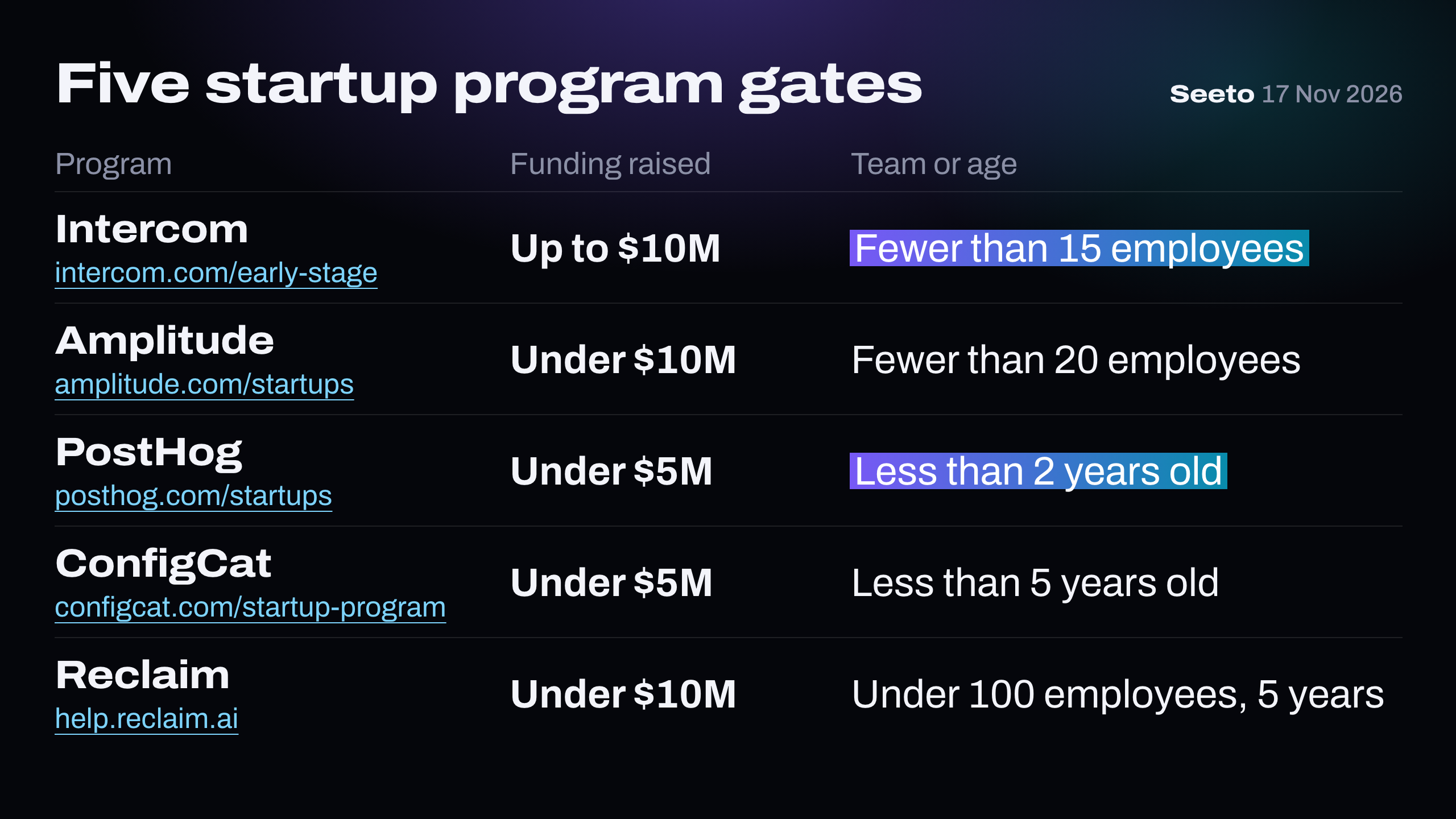
Intercom admits companies with up to $10M in funding and fewer than 15 employees. Amplitude's limit is fewer than 20 employees and less than $10M raised.
PostHog asks for a company less than 2 years old that has raised less than $5m. ConfigCat takes companies founded less than 5 years ago with under $5M in total funding. Reclaim sets three limits: under 100 employees, less than $10m raised, founded less than 5 years ago.
The gate is a statement about the customer the vendor wants later. A limit of 15 employees says the vendor expects the account to grow tenfold while it stays. A limit of 100 employees says the vendor will accept a company that is already a normal customer and discount it anyway.
Read how the gate is checked, too. GitLab asks applicants for a Crunchbase or Pitchbook profile, or a VC or accelerator webpage, and does not consider an application without one. A gate without a check is a public coupon.
2. The first-year offer: three shapes
The first-year offer comes in three shapes, and the shape tells you how the vendor bills.
- A percentage off. Intercom takes 93% off in year one. HubSpot gives Seed and Series A founders 90% off Year 1. ConfigCat takes 50% off its annual plans.
- A free period. GitLab gives a seed-stage company a free Ultimate licence for a year. Amplitude's first year is 100% free. Notion gives up to 6 months free on the Business plan. Zendesk's baseline term is 6 months.
- Credits. PostHog grants $50,000 in credits for 12 months. Credits suit a product billed on usage, because the startup can spend them on any part of the product.
Check the dollar value the page claims. Notion says its offer is worth "a maximum of $12,000 for 100 employees", with the Business plan at $20 per member.
That is 100 x $20 x 6 months = $12,000. A startup with 12 people gets 12 x $20 x 6 = $1,440.
Mixpanel's page says worth $145,000, costs $0, for a year with 1 billion events. The headline value is the list price of the maximum usage. Few startups use the maximum.
3. The step-down: year two
The step-down is the term that decides whether the program keeps its customers. It is also the term a quick reader skips.
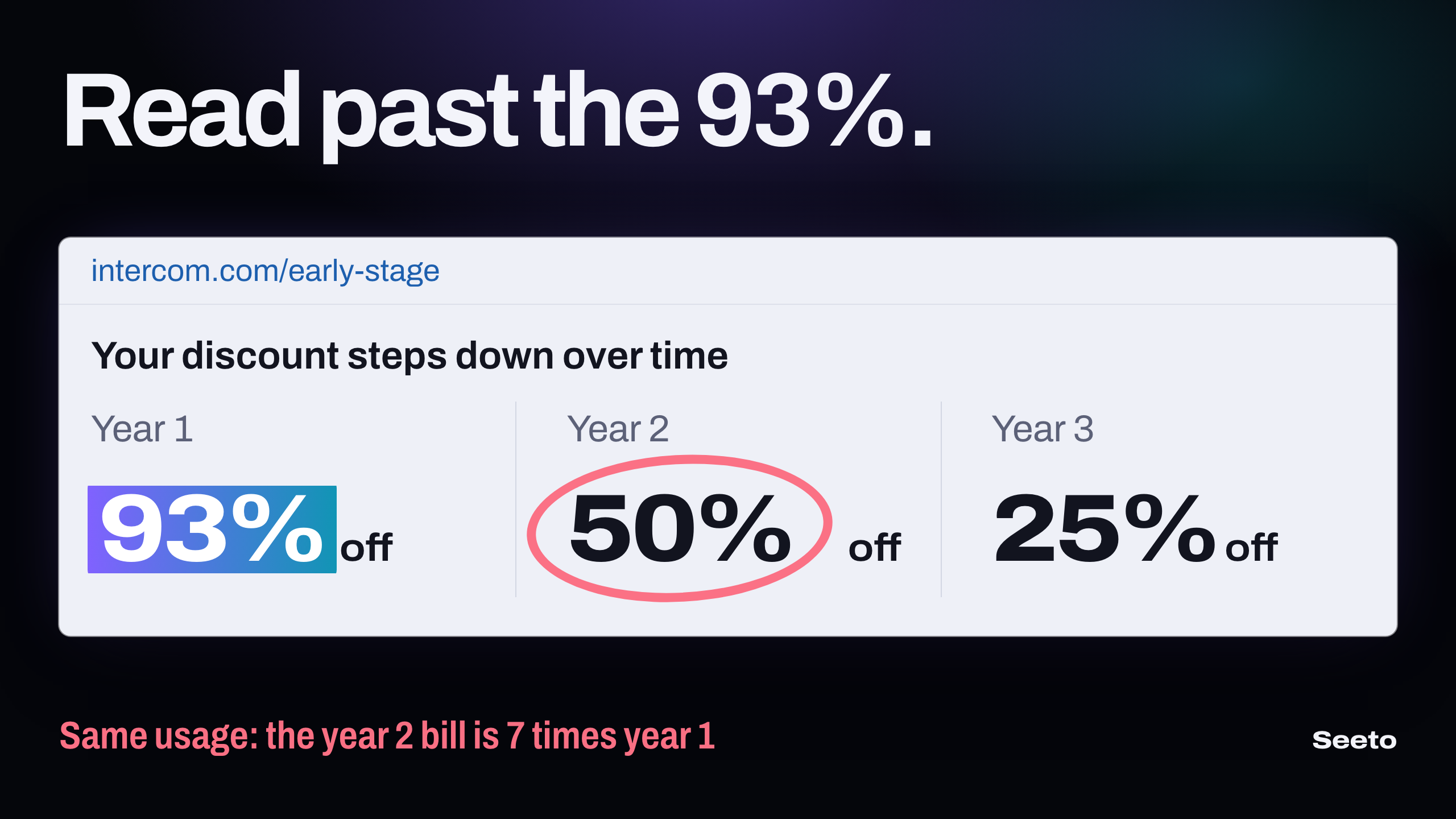
Intercom publishes all three years: 93% off in year one, 50% in year two, 25% in year three.
GitLab's seed tier goes from a free year to 50% off in year two. Its Series A and B tier goes from 50% to 25%. ConfigCat goes from 50% to 25%. Amplitude follows its free year with 40% off. Reclaim does not step down: it gives 20% off any plan for three years.
Turn each schedule into one number, the average discount over the program's life, so you can compare them:
- Intercom: (93 + 50 + 25) / 3 = 56% over three years
- GitLab, seed tier: (100 + 50) / 2 = 75% over two years
- Amplitude: (100 + 40) / 2 = 70% over two years
- ConfigCat: (50 + 25) / 2 = 37.5% over two years
- Reclaim: 20% over three years
The average hides the jump. A customer on 93% off pays 7% of the list price. On 50% off, the same customer pays 50%. At constant usage, the year-two bill is 50 / 7 = 7.1 times the year-one bill.
One practitioner guide advises vendors to tell startups upfront what they will pay when the program ends. Intercom does that on the page. Mixpanel's page says only that when the year is up, it will help the startup find the right plan.
4. The cap: what the discount covers
A discount applies to a quantity, and the quantity has a limit. The cap shows where the vendor expects a startup's bill to grow.
Intercom's plan includes 6 seats, and its free AI usage falls from 300 outcomes in year one to 150 in year two. GitLab's offer covers up to 20 seats, and support is not included. Amplitude's free year covers up to 100M events a month. Zendesk offers its platform for up to 50 agents.
Caps also move. PostHog's page says that from 14 September 2026 its startup credits no longer pay for its AI tools, and gives the reason: token-based pricing is unpredictable. That one sentence tells a competitor which part of PostHog's product has a cost problem.
5. The new-customer clause
Most programs are for new customers only. Intercom requires that the applicant is not currently an Intercom customer. GitLab writes "New customers only" on both tiers. Notion's offer is for non-paying customers who have not received a previous Notion promotion.
The clause shows the program's job: it buys new accounts and does nothing for the small customers the vendor already has. A founder who paid full price for six months reads that clause as a penalty for arriving early.
Reclaim took the other side. Its page says an applicant does not have to be a new user. That is a cheap move to copy when your competitor's clause annoys its own customers.
6. The partner tier
Many programs have two prices: one for a startup that applies alone, and a better one for a startup that arrives through a VC or an accelerator.
Notion gives 6 months free to a startup affiliated with one of its partners, 3 months to a startup with a business website and a company email, and 1 month to a company with under 10 employees. Zendesk accepts up to 250 employees for a partner referral and 50 without one. Its terms of 1 or 2 years are tied to its VC and accelerator partners.
The partner tier is a distribution channel. The investor does the first filtering and promotes the offer to a whole portfolio. If your competitor's best term is partner-only, its partner list is the page to read next. ConfigCat does the opposite and says applicants do not need a VC or an accelerator. That suits a vendor without a partnerships team.
7. What the startup owes in return
Some programs ask for something back, and the request shows what the vendor values more than the revenue.
Reclaim requires domain capture: employees who sign up with the company's domain join the team account automatically. That turns one discounted buyer into company-wide adoption. GitLab requires self-hosted users to enable usage and analytics features. ConfigCat applies its year-two discount once the commitments in its program agreement are met. PostHog issues credits once per founder and once per organisation.
A competitor that asks for data wants to learn how startups use the product. A competitor that asks for domain capture wants seats.
Price your own SaaS startup program
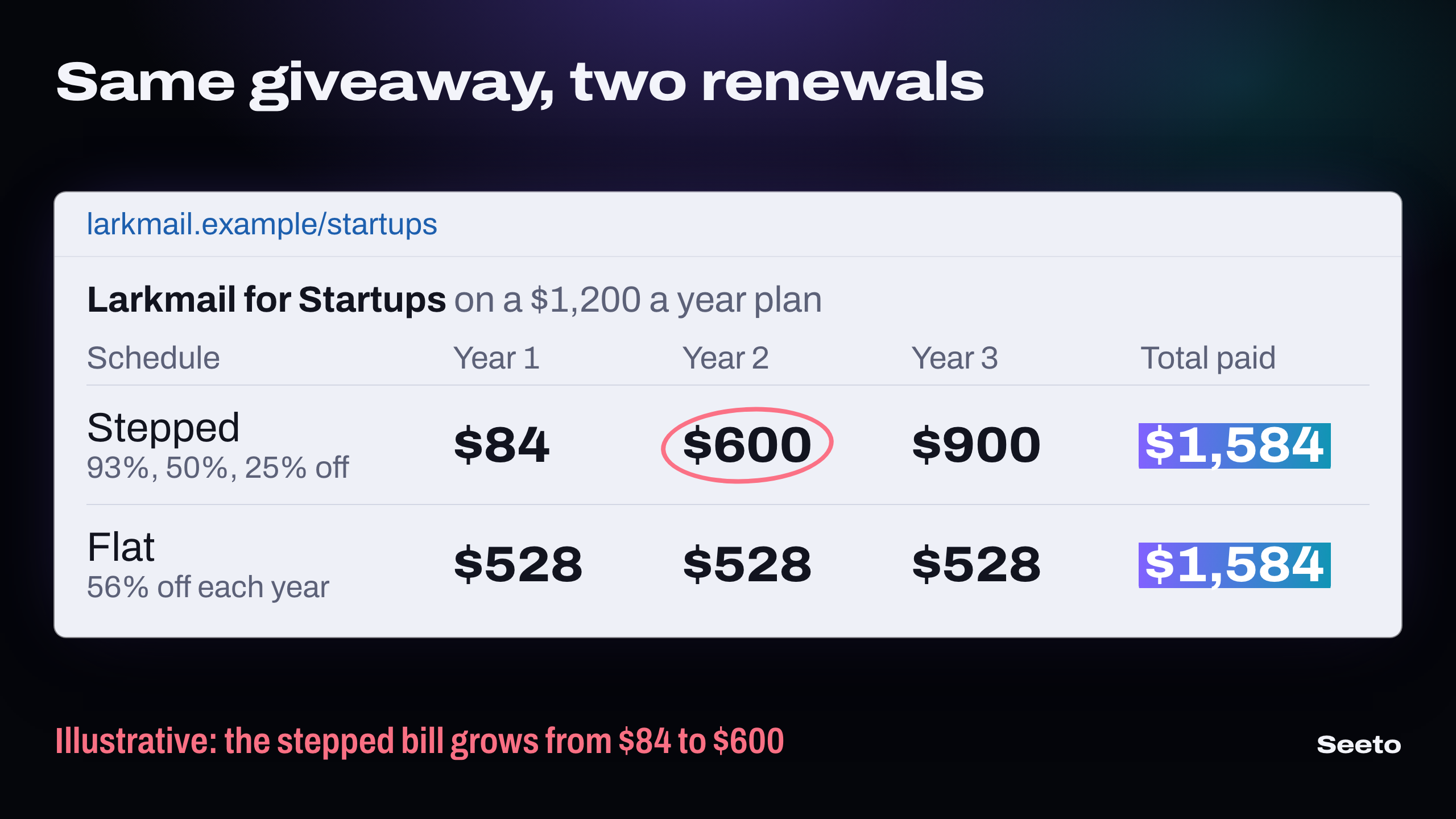
Take Larkmail, a made-up product with a plan at $100 a month, or $1,200 a year. Larkmail copies the most generous schedule above: 93%, 50%, 25%.
- Year one: $1,200 x 0.07 = $84
- Year two: $1,200 x 0.50 = $600
- Year three: $1,200 x 0.75 = $900
The startup pays $84 + $600 + $900 = $1,584 of the $3,600 list price. Larkmail gives away $2,016, which is 56%.
Now price the same giveaway as a flat discount. 56% off for three years is $1,200 x 0.44 = $528 a year, and 3 x $528 = $1,584. Larkmail collects the same money from an account that stays. The difference is the renewal. The step-down schedule sends a bill that grows from $84 to $600. The flat schedule sends the same $528 three times.
The stepped schedule wins a comparison of headlines, because 93% is larger than 56%. It also needs the customer to accept a bill seven times larger after 12 months. Choose it only when your product is hard to leave after a year. If a customer can leave in a week, a smaller, flat discount keeps more of them.
Set the headline against your competitors' pages, the same way you would set an annual discount or a free trial length. If a competitor answers your program with a free plan, read its limits first.
How Seeto reads these pages
Seven terms on ten pages is seventy facts, and each of them can change without an announcement. PostHog changed what its credits cover in September. A gate moves from $5M to $10M, a step-down gains a third year, and nobody on your team sees it, because nobody reopens a competitor's program page.
Seeto solves this. You paste your URL and your competitors' URLs, and an agent reads their real pages. In 5 to 15 minutes you get a pricing comparison with their plans and prices side by side, next to a features matrix, messaging and battle cards. Every fact carries the page it came from, so you can open the page and confirm the list price that a competitor's 93% is taken from.
On the Pro plan, Seeto runs the analysis again on a schedule and compares it with the previous run: what changed, and where. A price that moved shows up as a change with its source. The plan limits are on the pricing page.
Questions about startup programs
What is a SaaS startup program?
It is a time-limited offer for young companies: a percentage off, a free year or a credit grant. A gate decides who gets in, usually a funding limit plus a headcount or company-age limit.
How large is a typical startup program discount?
The first year is often 90% or more. Intercom takes 93% off, HubSpot 90%, and GitLab and Amplitude give the first year free. Smaller vendors offer less for longer: ConfigCat 50% then 25%, Reclaim 20% for three years.
Do you need a VC or accelerator partner to offer one?
No. ConfigCat says applicants do not need a VC or an accelerator. Partners help when you want someone else to filter applicants: Notion and Zendesk both give partner-referred startups longer terms.
What happens when a startup program ends?
The discount steps down or stops. Intercom goes from 93% to 50% to 25% over three years. At the same usage, the year-two bill is about seven times the year-one bill, so the first renewal is the real test of the program.
Start with your two closest competitors. Open their program pages, write down the seven terms with the date and the address, and work out the average discount and the year-two jump. Then let the reading run without you: create a free Seeto account, add those two competitors, and read their pricing side by side today.