SaaS free trial length: read your competitors first
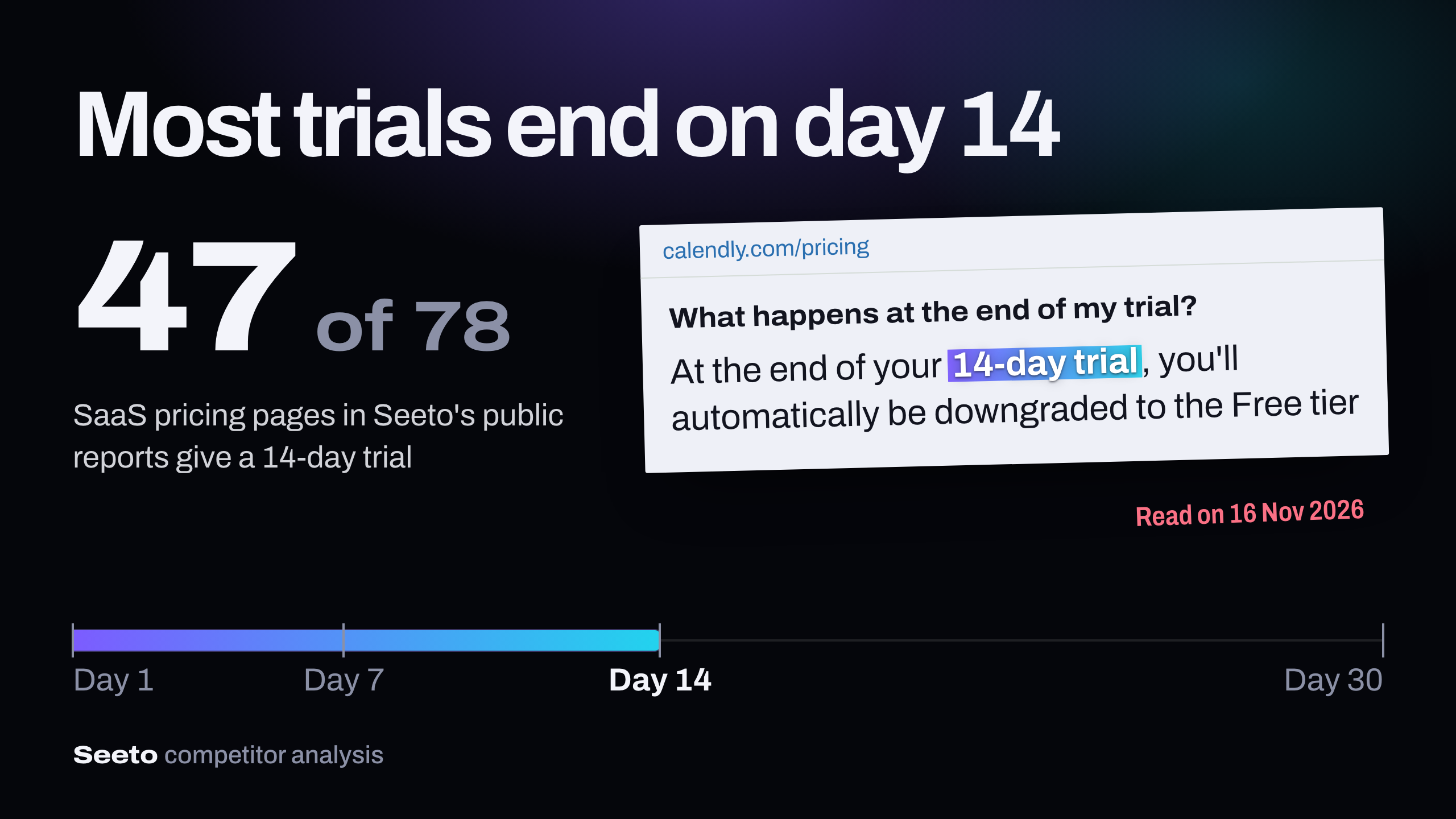
The usual SaaS free trial length is 14 days. In Seeto's public reports, 47 of 78 products that state a trial give 14 days, 13 give 30 and 11 give 7. Do not copy the average. Set your trial length against your direct competitors' trials, and compare the terms around the days: the card, the plan and the last day.
A trial is a public promise on a pricing page. Your competitors make that promise to the buyers you want. When a buyer starts two trials on the same Monday, the trial that ends first asks for a decision first. This guide shows what competitors offer, what the research says about length, how to read a competitor's trial, and what a change to a trial tells you.
What SaaS free trial length do competitors offer?
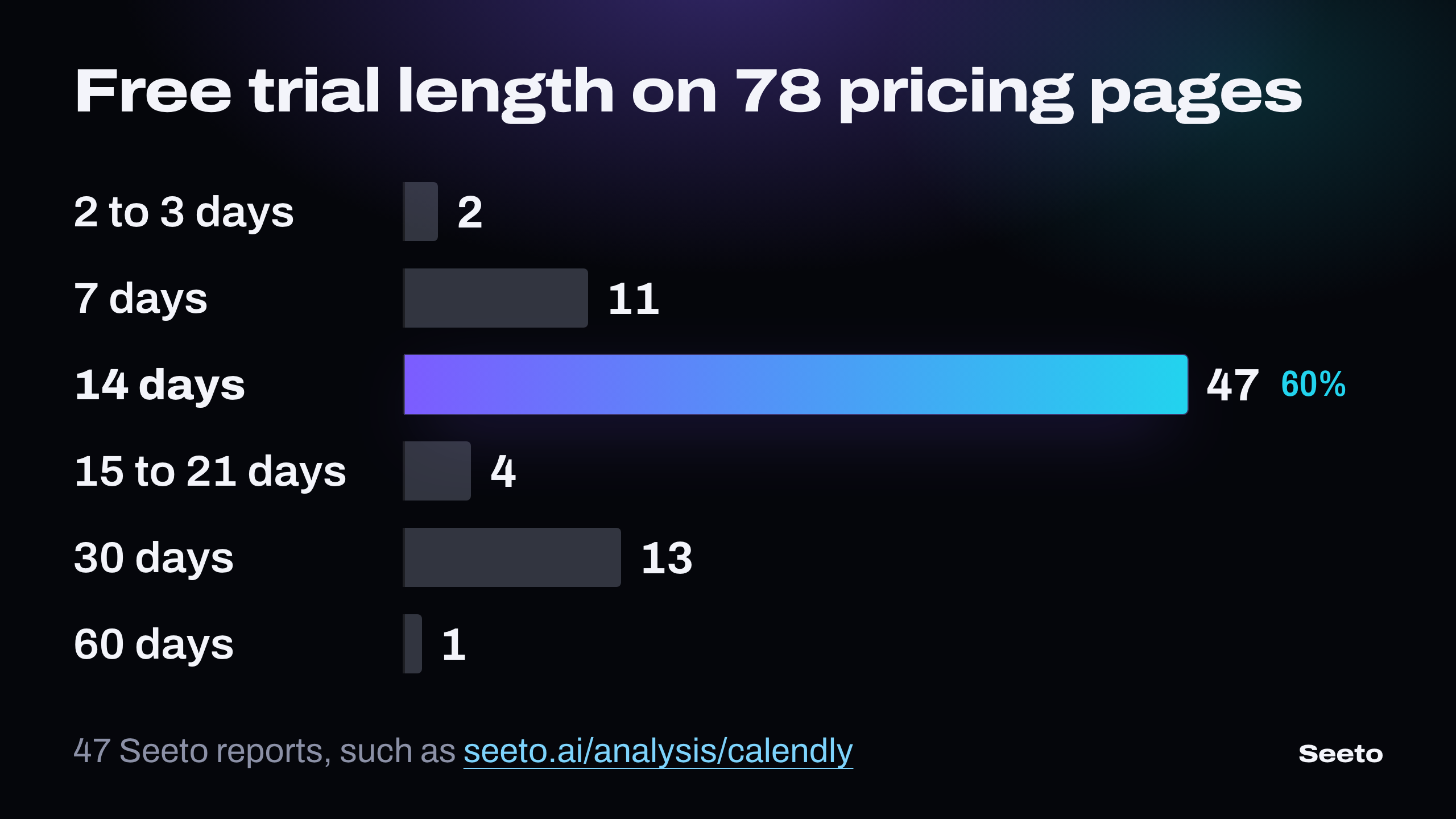
Seeto's 47 public reports read the pricing pages of more than 400 SaaS products between April and November 2026. On 78 of those pages, the trial has a stated number of days. Fourteen days is the clear default: 47 products, or 60%. Thirty days is second with 13 products, and 7 days is third with 11.
An outside count agrees. ChartMogul's SaaS conversion report studied 200 software products in January 2026. It found that 62% use a 14-day trial, 14% use 7 days and 14% use 30 days.
The average hides the spread inside one category. Behavior analytics is a good example. Lucky Orange offers 7 days, and Crazy Egg makes all plans free for 30 days. Mouseflow gives 14 days, and UXCam starts all plans with a 14-day trial.
A buyer who compares these four tools sees four different clocks. Seeto's Hotjar report puts the four pricing pages side by side.
Does a longer trial convert better?
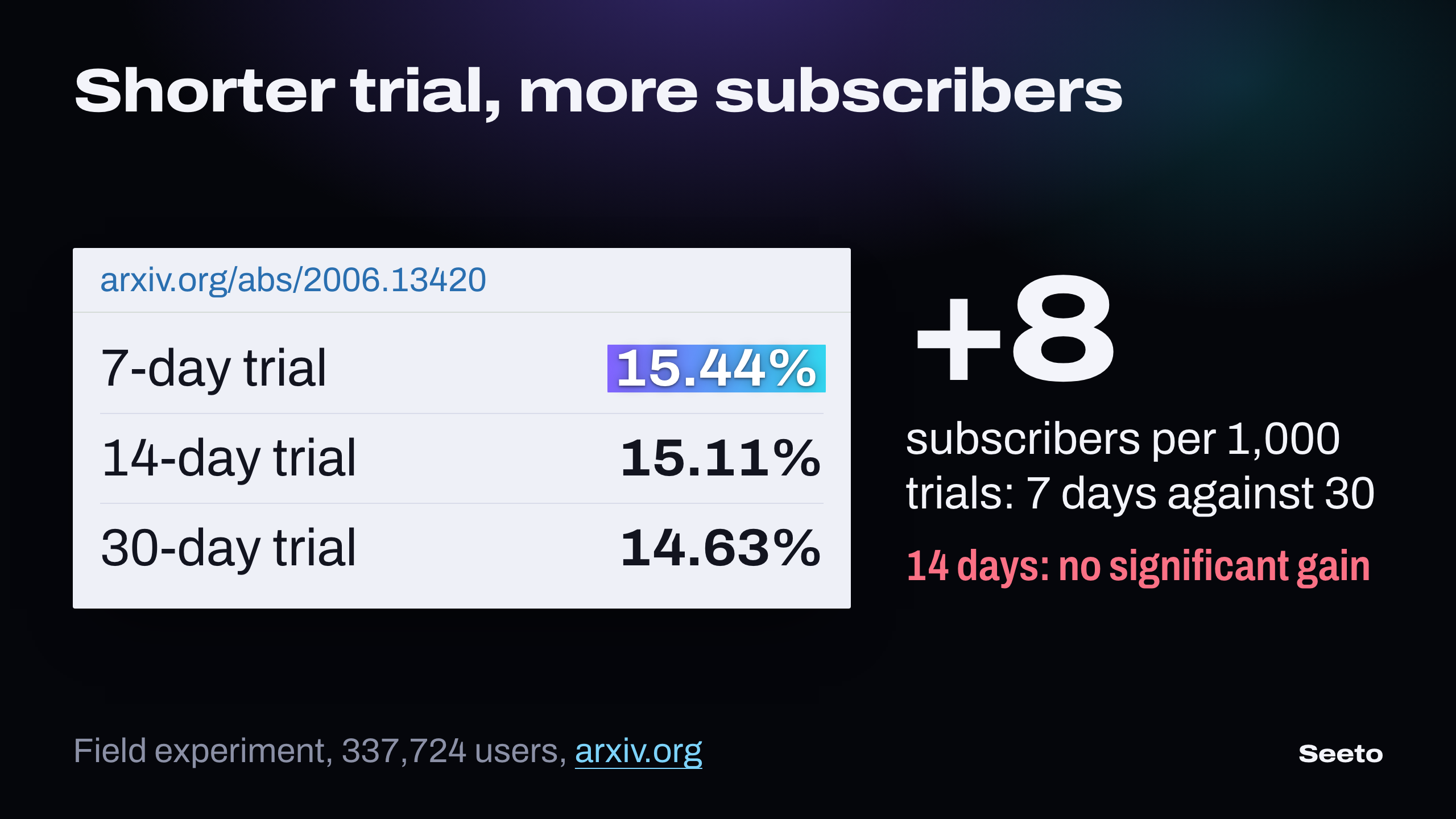
No, not in the best evidence available. In a field experiment with 337,724 users at a SaaS firm, new users got a 7-, 14- or 30-day trial at random. The 7-day trial gave the most subscriptions: 5.59% more than the 30-day trial. The 14-day trial was not significantly different from the 30-day trial.
A smaller analysis points the same way. Tomasz Tunguz reported MadKudu's data from nine companies. In six of the nine, half of the paying customers converted by day 14. His conclusion is that longer trials do not convert customers at greater rates.
The card is a bigger lever than the days. ChartMogul found that only 20% of trial products ask for a card at signup. Those trials convert at 30%, more than five times the rate of trials without a card. That rate counts only the people who agreed to give a card, so compare it with your signup numbers, not with the no-card rate alone.
A worked example: what 7 days are worth
Use the experiment's own rates. In its test data, 14.63% of the users on the 30-day trial subscribed. On the 14-day trial the rate was 15.11%, and on the 7-day trial it was 15.44%.
Take 1,000 trial starts a month:
- 30 days: 1,000 × 14.63% = 146.3 subscribers.
- 7 days: 1,000 × 15.44% = 154.4 subscribers.
- The difference: 154.4 − 146.3 = 8.1 more subscribers.
- The gain: 8.1 ÷ 146.3 = 5.5%. The paper gives 5.59% because it uses the unrounded rates.
Eight more customers in a thousand trials is a real gain. It is not a reason to copy a competitor's trial length.
If your main competitor gives 30 days and you give 7, a buyer who compares you both meets your price three weeks earlier. That helps only when your product shows its value in the first week. Your time to value sets the length, and your competitors' trials tell you how a buyer will see it.
Read the four terms around the number
A trial line on a pricing page has four parts. Compare each part, not only the days.
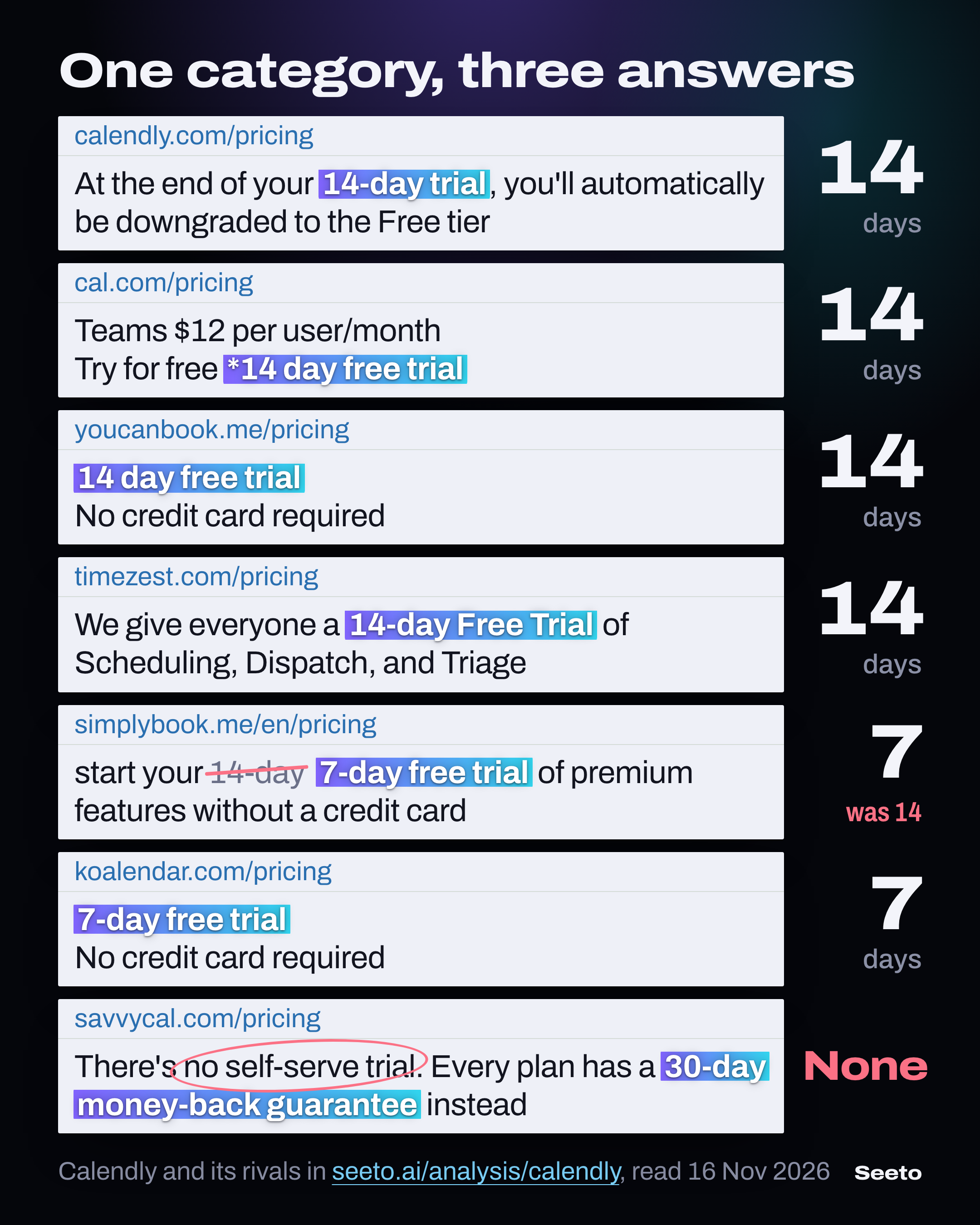
Scheduling shows how far one category spreads. Seeto's Calendly report lists these tools as Calendly's competitors. Today their pricing pages give four 14-day trials, two 7-day trials and one refund window. A buyer who starts Calendly and Koalendar on the same day sees Koalendar's trial end a week before Calendly's.
- The length. Count the days, and check which plans the trial covers. Cal.com gives its 14-day trial on the Teams and Organizations plans. Individuals use a free plan.
- The card. SimplyBook.me starts its trial without a credit card. Koalendar shows "No credit card required" under its Pro trial.
- The plan inside the trial. Mouseflow's trial gives 2,000 sessions, 5 websites, 10 funnels and 1 month of data history. A limit like this tells you which use the competitor wants a buyer to test.
- The last day. Calendly moves the account to the Free tier at the end of its 14-day trial. SimplyBook.me asks the user to select a plan to continue. YouCanBook.me lets the user upgrade or keep the free-forever version.
Some competitors give no trial at all. SavvyCal has no self-serve trial and gives a 30-day money-back guarantee on every plan instead. That is a different bet: the buyer pays first and gets a window to ask for a refund.
What a change to a competitor's trial tells you
Trials change quietly, and a change has a few likely readings. The competitor may want buyers to decide sooner, cut the cost of free users, or test conversion. One change is not a strategy.
Write down the date, read the rest of the pricing page for a second change, and check the page again in a month. If the free plan or the prices move too, read the moves as one decision, as when a competitor launches a free tier. Do not copy the change on the same day: your own time to value decides whether a shorter trial raises your subscriptions.
SimplyBook.me is a recent example. Its pricing page said "14-day free trial" in the archived copy of 29 October 2026. The archived copy of 11 November 2026 says "7-day free trial", and the live page says the same today. Every trial line on the page changed: the plan table, the FAQ and the sentence about the end of the trial.
How Seeto keeps competitors' trials in view
Seeto solves this problem. You paste your URL and your competitors' URLs, and an agent reads their real pages. In 5 to 15 minutes you get a features matrix, a pricing comparison, messaging, a positioning map, SEO, battle cards, ad intelligence, a competitive score and an investor report.
The pricing comparison sets each competitor's plans side by side, with the trial where the pricing page states it. Every fact carries the page it came from, so you can open the line and read it again.
A trial change is where Pro helps most. Pro re-runs an analysis on a schedule and compares it with the previous run. When a competitor cuts its trial from 14 days to 7, the comparison names the change and the page where it happened. The Free plan gives you 1 analysis a month with 2 competitors, and the other plans are on the pricing page.
Questions about SaaS free trial length
Is 14 days the right SaaS free trial length?
It is the most common length, not the best one for every product. In the field experiment, 14 days did no better than 30 days, and 7 days did better than both. Pick the shortest trial in which a new user reaches the first result your product promises.
Should a free trial ask for a credit card?
Most do not: ChartMogul counted 20% of trial products that ask for a card. Trials with a card convert at a much higher rate, but that rate counts only the people who gave a card. Compare it with your signup numbers before you change.
Should my trial be longer than my competitors' trials?
Only when your product needs the time. In the evidence above, a longer trial does not convert at a higher rate. If a competitor gives 30 days and you give 14, say plainly what a buyer can finish in your 14 days.
Is a money-back guarantee a replacement for a trial?
It can be. SavvyCal has no self-serve trial and gives a 30-day money-back guarantee on every plan. The buyer pays on day one and can ask for a refund within 30 days.
Open the pricing pages of your three closest competitors today. For each one, write down four things: the days, the card, the plan and the last day. Then run a free analysis in Seeto to see their plans side by side, each with the page it came from.